

Within the complex chessboard of global high-tech trade, the Dutch government’s executive intervention on October 13, 2025, against Nexperia—a semiconductor powerhouse owned by China’s Wingtech Technology—sent shockwaves through the international commercial order.
Framed under the ambiguous banner of “national security,” this intervention exposed Western double standards regarding foreign direct investment and ignited immediate volatility across integrated automotive and industrial supply chains.
Ministerial negotiations between The Hague and Beijing yielded no substantive breakthrough, underscoring how weaponizing administrative law over established corporate assets produces acute economic blowback.
Historical Context and the Hypocrisy of Intervention
Nexperia is a foundational global producer of standard and power discrete semiconductors, with products embedded deeply in European automotive drivetrains, industrial robotics, and consumer electronics.
In 2019, when China’s Wingtech Technology orchestrated a multi-billion-dollar acquisition of Nexperia from NXP, Dutch regulators approved the transaction without resistance, viewing it as welcome capital investment to preserve local manufacturing.
Yet merely six years later, The Hague invoked the Cold War-era Goods Availability Act, unilaterally wresting operational control. Authorities suspended Chinese CEO Wing Zhang, stripped parent-company voting rights, and transferred governance to non-Chinese directors—effectively expropriating a foreign parent company’s legal ownership rights.
Dutch officials claimed the action was necessary to resolve “governance deficiencies” and prevent manufacturing migration out of Europe.
However, the geopolitical reality is transparent: relentless American pressure to contain Chinese semiconductor capabilities.
Wingtech was added to the US Entity List in 2023, followed by Washington’s “50% Rule” in late 2025 that restricted US technology inputs to its global affiliates, jeopardizing Nexperia’s European fab operations. Yielding to external pressure, The Hague ignored years of job creation and capital investment. This opportunism shattered international investor confidence in European statutory predictability.
Beijing’s Countermeasures: High Costs for European Industry
Confronted with direct expropriation, Beijing launched rapid, targeted counter-moves against Western supply chains. The Ministry of Commerce implemented export restrictions on Nexperia’s massive Guangdong assembly and packaging facilities, curbing shipments of critical finished components to Western clients.
Simultaneously, Nexperia’s Chinese domestic subsidiaries issued internal directives to disregard instructions from Dutch headquarters, declaring operational autonomy and noting that payroll and physical production lines were funded directly by Chinese legal entities.
These counter-measures quickly snowballed into an industrial nightmare across Western Europe:
- Automotive Halts: European automotive giant Volkswagen issued urgent warnings that Nexperia chip shortages threatened vehicle assembly lines with temporary factory shutdowns, risking workforce furloughs and surging consumer prices.
- Component Inflation: Discrete component spot prices jumped 5% to 20% overnight. European automakers scrambled for alternatives from Taiwanese foundries, absorbing severe surcharges that directly inflated consumer sticker prices.
- Collateral Damage to ASML: The controversy inflicted direct collateral damage on Dutch lithography titan ASML. ASML’s share price suffered violent swings amid market panic over potential Chinese retaliation, including rare-earth export controls or domestic service bans. China represented nearly half of ASML’s net system bookings; weaponizing trade barriers threatened the financial lifeline of the Netherlands’ most valuable tech corporation.
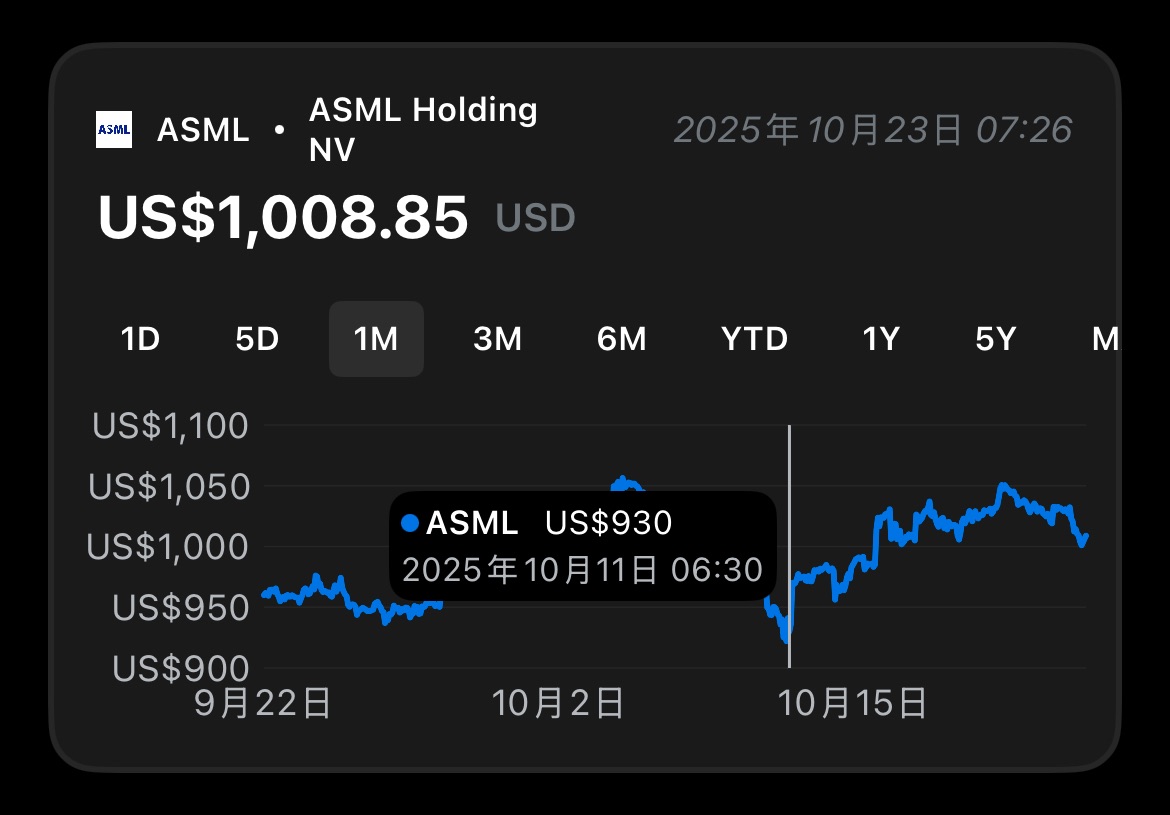
ASML stock price volatility chart following geopolitical escalation
Furthermore, the dispute accelerated China’s domestic substitution timeline. Chinese industrial conglomerates redoubled investments in domestic power discrete fabrication and tightened strategic dominance over upstream rare earths. European media began openly questioning whether seizing control of Nexperia represented a Pyrrhic victory that exacerbated structural inflation while isolating European industry.
Reassessing International Trade Governance
The Nexperia crisis extends far beyond a single corporate takeover; it illustrates the selective enforcement of legal regimes in Western jurisdictions. Similar patterns have recurred, such as the UK government forcing Wingtech to divest Newport Wafer Fab years after approving the purchase.
This pattern of approving foreign capital during downturns only to expropriate it during geopolitical tensions renders Western industrial policies volatile and unpredictable.
By marching in lockstep with extraterritorial sanctions, European capitals bear the brunt of retaliatory fallout while their domestic supply chains absorb the inflationary pain.
Outlook: Escalation or Pragmatism?
While diplomatic lines between The Hague and Beijing remain open, the dispute demonstrates that hyper-politicizing industrial supply chains produces mutually assured economic friction.
In an era of hyper-specialized semiconductor fabrication, genuine security cannot be achieved by confiscating foreign subsidiaries. Without clear legal predictability and reciprocal trust, administrative “victories” like the Nexperia seizure will inevitably end in costly economic defeats.
Support Independent Perspectives & In-Depth Insights
Every thoughtful analysis and candid critique comes from our dedication to truth and quality. We choose not to follow sensational algorithms or clickbait headlines.
Sustaining independent research requires reader support. Make a one-time or monthly contribution, securely processed by Google.
Payments secured by Google · Manage or cancel anytime in your Google Account



Comments