
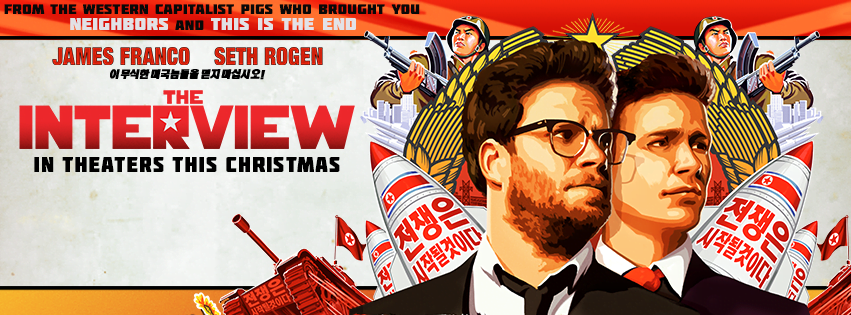
The most contentious movie of recent times is no longer about an actress baring skin or an actor courting scandal. Sacrifices supposedly made in the name of art pale in comparison to The Interview, a comedy revolving around the assassination of Kim Jong-un.
The directors didn’t just pack The Interview with political satire and espionage slapstick; in the real world, the production was completely swallowed by geopolitics and cyber warfare. Originally slated for a Christmas Day theatrical release on December 25, Sony abruptly announced three days ago (December 18) that they were pulling the plug.
Cancellations due to foreign diplomatic protests or religious objections aren’t unprecedented, but they usually occur within individual overseas territories. For a studio to pull a major holiday blockbuster within the United States itself is exceptionally rare—prompting even President Barack Obama to address the decision during a White House press briefing.
Why did it come to this?
As most know, North Korea (DPRK) remains a tightly insulated totalitarian regime where possessing foreign media is severely penalised, and domestic hackers develop sophisticated intrusion capabilities almost exclusively through state sponsorship.
Consequently, when Sony Pictures suffered a devastating cyberattack in early November—resulting in massive leaks of confidential employee records, internal executive emails, contracts, unproduced screenplays, and five full-length unreleased feature films [1, 2]—it was widely interpreted as Pyongyang’s retaliatory strike against a film deemed “disrespectful to their supreme leader” (especially ironic given Kim Jong-un’s reported fondness for movies).
After Sony Pictures decided to pull the release of The Interview, President Obama stated at a press conference the following day that Sony had made “a mistake.”
Pyongyang, meanwhile, denied direct involvement in hacking Sony’s networks, framing the breach as a “righteous deed” carried out by sympathetic supporters.
That denial is somewhat plausible. Breaching Sony’s security infrastructure was hardly novel—after all, the PlayStation Network had previously suffered a catastrophic intrusion compromising the personal data of nearly 80 million gamers.
It is entirely possible that the attackers didn’t breach Sony solely over this film, but rather capitalized on the international controversy to haul in loot from digital nets cast deep into Sony’s corporate network long beforehand, letting North Korea take the notoriety.
Yet the official narrative—from President Obama’s public remarks to the FBI investigation—firmly framed the cyberattack as hostile state aggression by North Korea, marking one of the first times Washington publicly attributed a major corporate attack directly to a foreign government.
In the evidence released regarding the November 24 intrusion, investigators cited forensic links including compromised servers in Bolivia previously tracked by the FBI, proprietary North Korean cryptographic tools and malware signatures, and known North Korean IP ranges communicating with Sony’s systems.
The FBI stated bluntly: “The FBI now has enough information to conclude that the North Korean government is responsible for these actions. These actions were intended to inflict significant harm on a U.S. business and suppress the right of American citizens to express themselves.” The bureau added: “We cannot have a society in which some dictator in some place can start imposing censorship here in the United States. Because if somebody is able to intimidate folks out of releasing a satirical movie, imagine what they start doing when they see a documentary or a news report they don’t like.”
That rhetoric struck directly at the foundational core of the American ethos: freedom.
Resolved: That these United Colonies are, and of right ought to be, free and independent States, that they are absolved from all allegiance to the British Crown, and that all political connection between them and the State of Great Britain is, and ought to be, totally dissolved.
The Interview: Plot Synopsis
Celebrity tabloid host Dave Skylark (James Franco) and his producer Aaron Rapaport (Seth Rogen) discover that North Korean leader Kim Jong-un is an avid fan of their television show Skylark Tonight. They manage to land an exclusive sit-down interview with him in Pyongyang.
As they prepare to travel to North Korea, the CIA recruits the eccentric duo to turn their journalistic mission into a covert assassination operation [1].
Official Trailer
https://www.youtube.com/watch?v=DkJA1rb8Nxo
Even with the theatrical release cancelled and its commercial fate hanging in the balance, user ratings on IMDb surged to an unprecedented perfect score, with over 18,400 user votes pouring in within days (I cast a ballot myself).
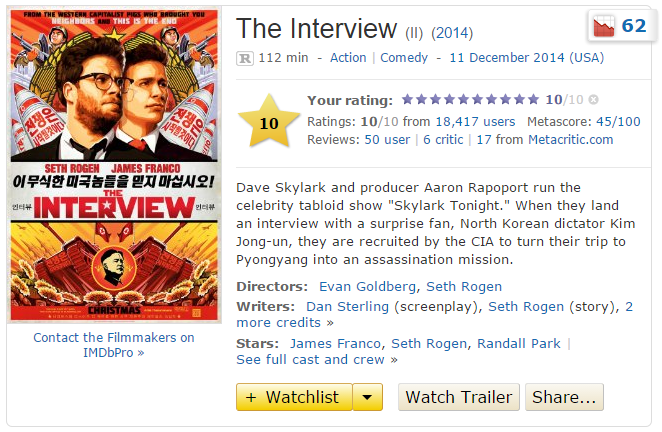 IMDb Perfect Rating
Whether intense public curiosity will eventually prompt Sony to reconsider releasing the film remains to be seen.
Even if revived, international sensitivities often trigger drastic alterations. For instance, the 2012 remake of Red Dawn, which initially depicted an invasion of the American mainland by the Chinese People’s Liberation Army, reportedly digitally replaced all Chinese insignias, flags, and uniforms with North Korean ones during post-production to preserve box-office access in mainland China.
Once again, North Korea served as the ultimate cinematic scapegoat.
Further Reading
- Wikipedia: The Interview.
- The scale of the breach is staggering: five unreleased films along with voluminous internal communications represent enormous quantities of unstructured data, yet prolonged outbound exfiltration went unnoticed by internal enterprise security.
- IMDb: The Interview.
- The Interview: Sony Pivots to Digital Rental at $5.99 on Online Platforms.
Support Independent Perspectives & In-Depth Insights
Every thoughtful analysis and candid critique comes from our dedication to truth and quality. We choose not to follow sensational algorithms or clickbait headlines.
Sustaining independent research requires reader support. Make a one-time or monthly contribution, securely processed by Google.
Payments secured by Google · Manage or cancel anytime in your Google Account


Comments