
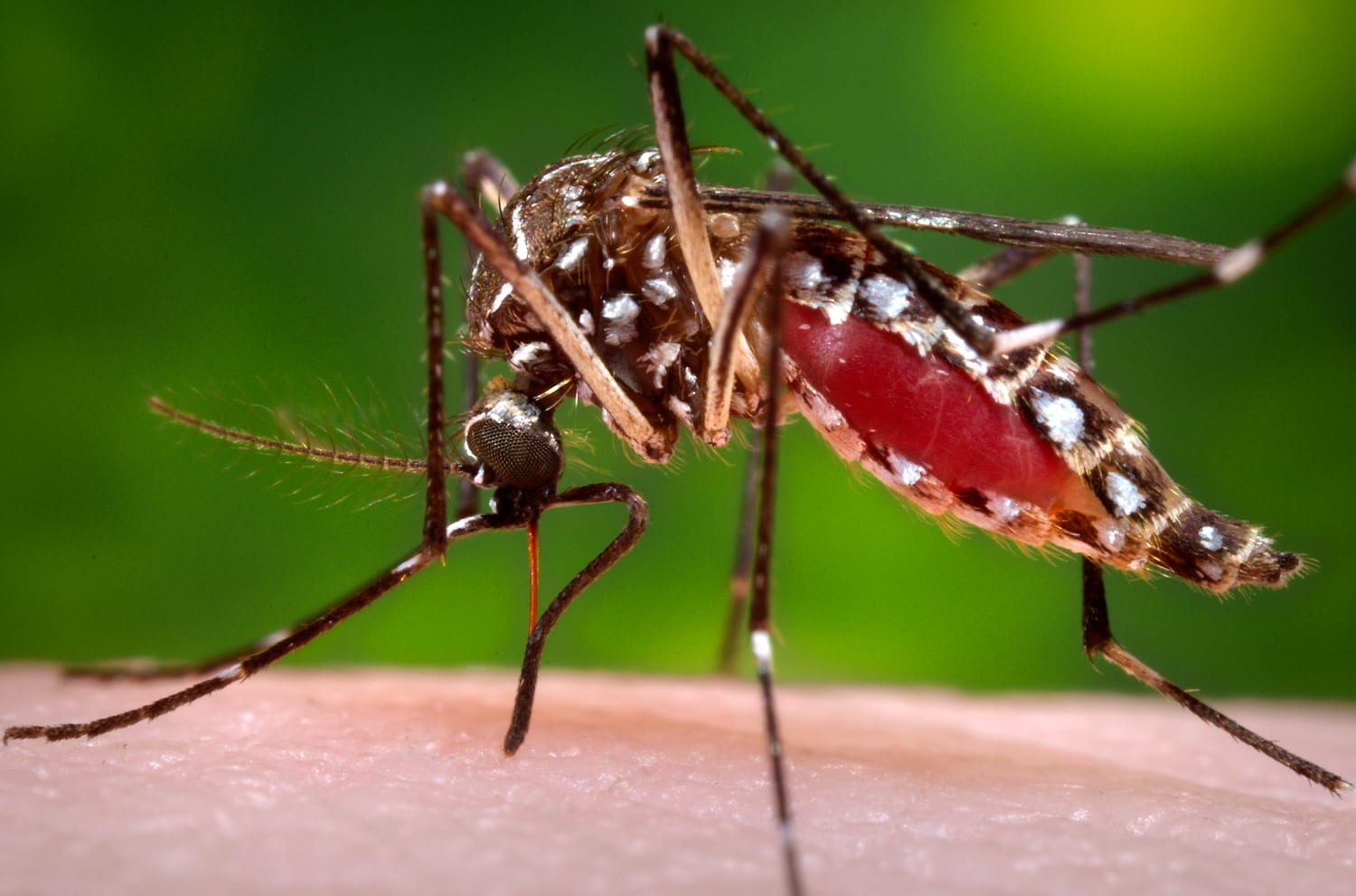
As summer arrived, dengue fever—classified as a Category 2 notifiable communicable disease—has grown increasingly severe. Across the Republic of China, confirmed cases this year have reached 5,467 with 12 fatalities. Tainan alone accounts for 4,585 confirmed cases, representing nearly 90% of the nationwide total.
Following this news, many travelers eager to steer clear of high-risk outbreak zones have contacted hotels and homestays to cancel reservations, voluntarily calling off visits to Tainan planned for the coming weeks or even months.
According to statistics from the Centers for Disease Control (CDC) under the Ministry of Health and Welfare, confirmed cases just last week surged by 621 compared to the three-week average, and jumped by 1,271.33 compared to the average for the same period over the past three years.
CDC health experts warned that if the outbreak cannot be brought under control in September, the total number of infections this year could spiral out of control, with some media projecting figures as high as 30,000 cases.
Furthermore, CDC statistical data reveals a sobering picture. In the chart below, the blue arrow on the left points to confirmed dengue cases in week 35 of 2014, while the blue arrow on the right indicates confirmed cases in week 35 of this year (August 23–29). It is immediately apparent that cases during the same period last year made up only a small fraction of the total. Taking the 2014 distribution pattern as a reference, the number of infections over the next two to three months could reach unimaginable heights.
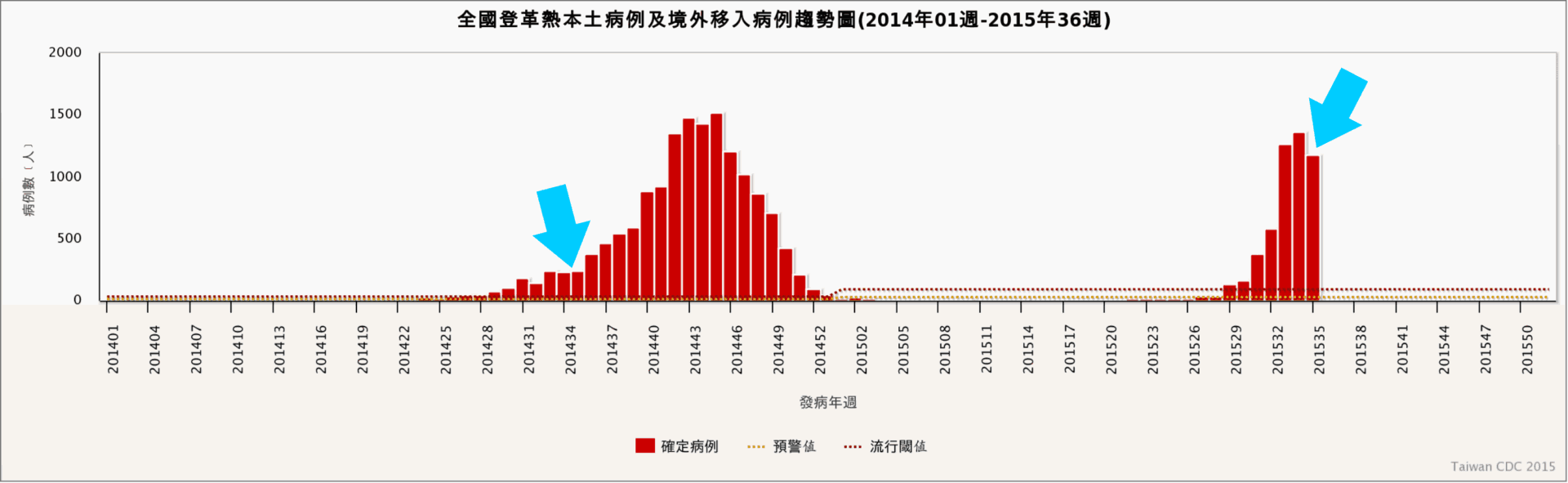 CDC distribution chart of confirmed dengue fever cases over the past 88 weeks
However, even though the dengue outbreak has entered a dangerous peak, domestic regulatory authorities (such as the Tourism Bureau or the CDC) have not issued explicit travel advisory tiers akin to the Bureau of Consular Affairs under the Ministry of Foreign Affairs [4]. Furthermore, dengue outbreaks are not legally classified as a “natural disaster” domestically. Consequently, if you plan to request a cancellation from a hotel operator, remember that you must cancel at least 14 days in advance; otherwise, under standard hotel contract regulations, you cannot receive a full refund [3].
Although several star-rated hotels have stated they are stepping up comprehensive environmental disinfection and offering complimentary mosquito repellent and mosquito zappers to guests, lodging only represents a small portion of a full day’s travel itinerary. In other words, any destination where diseases spread easily is bound to raise concerns for travelers. According to Hsu Hsin-chuan, Chairperson of the Tainan City Hotel Association, hotel occupancy across Tainan has already plunged by roughly 30% due to the outbreak—clear proof of the public’s desire to steer clear of high-risk outbreak hotspots.
Additionally, under Article 6 of the “Regulations Governing Rewards for Communicable Disease Prevention and Control,” anyone who proactively visits a designated authority for dengue screening that confirms an imported or domestic case is eligible for a reporting bounty of NT$2,500.
Finally, an editorial reminder: if you genuinely must travel to areas like Tainan, Kaohsiung, or Pingtung in the near future for leisure or business, please remember to bring along insect repellent products and minimize mosquito bites as much as possible (herbal or plant-based repellent options are generally recommended). We hope everyone enjoys safe travels and returns home healthy—there is truly no need to gamble with your health, right? (Unless you are really after that NT$2,500 reporting bounty!)
Further Reading:
- CDC Communicable Disease Reporting and Consultation Hotline: “1922”.
- CDC: Understanding Dengue Fever.
- According to the “Standard Form Contract for Direct Booking Between Individual Travelers and Tourist Hotel / Hotel / B&B Operators,” guests terminating a reservation must notify the operator and may request a refund of deposit according to the following schedule: 100% full refund for cancellations 14 days or more in advance; 70% refund for 10–13 days; 50% for 7–9 days; 40% for 4–6 days; 30% for 2–3 days; 20% for 1 day in advance. If cancellation is requested on the check-in date itself, the operator is not required to refund the deposit.
- The Taipei City Department of Health provides an epidemic prevention alert signal, currently set to yellow-red indicating “confirmed indigenous dengue cases identified in the city,” though in practice this is not officially recognized as valid proof for fee-waiver hotel refund claims.
Support Independent Perspectives & In-Depth Insights
Every thoughtful analysis and candid critique comes from our dedication to truth and quality. We choose not to follow sensational algorithms or clickbait headlines.
Sustaining independent research requires reader support. Make a one-time or monthly contribution, securely processed by Google.
Payments secured by Google · Manage or cancel anytime in your Google Account



Comments