
Flying Cow Ranch is a well-known recreational farm in the Republic of China. This article records family travel reference material researched nearly ten years ago for Wan-Chen, preserved here solely as a personal keepsake and format archive.
Much of the text consists of excerpts from official descriptions, originally compiled purely for private use. If you need to make use of sections below, please keep in mind that this article primarily organizes detailed planning for surrounding attractions.
Original Planning for the Two-Day Tour of Flying Cow Ranch
Ranch Profile
- Ranch Name: 1975 Central Youth Dairy Village → 1995 Flying Cow Ranch
- Total Area: Operating tourist area is about 50 hectares; total management area (including forage planting and dairy cattle breeding) spans approximately 120 hectares
- Topography: Low-altitude gentle hillside terrain at an elevation of roughly 180m–270m
- Dairy Cattle: Currently raising around 450 Holstein dairy cows (about 20 within the tourist ranch area)
- Address: No. 166, Nanhe Li, Tongxiao Township, Miaoli County 357
- Phone: 037-782999 (Inquired: Pets/VIVI are not allowed in accommodations)
- Fax: 037-782399
- Website: http://www.flyingcow.com.tw
- Origin of “Flying Cow”: “Flying” represents butterflies, while “Cow” represents dairy cattle.
- Color Imagery: The signature Flying Cow green is blended in precise proportions from blue, white, and green:
- Blue represents joyful holiday living;
- White symbolizes healthy dairy production;
- Green embodies sustainable natural ecology.
 Flying Cow Ranch Logo
Ranch Mission
Through an integrated development strategy of “Three Lives” (Living, Production, Ecology) and “Three Educations” (Cultivation, Conservation/Restoration, Education), the ranch aims to sustainably operate a leisure enterprise that blends education with entertainment, offering guests a holistic wellness experience for body, mind, and soul.
In the 1970s, as the economy of the Republic of China began to take off, fresh milk—once an aristocratic luxury reserved for the wealthy—gradually gained acceptance among the general public. To encourage citizens to develop the habit of drinking fresh milk, the government selected a cohort of young people (including dairy farmers, civil servants, and teachers) in 1973 and sent them to the United States and New Zealand in batches for professional dairy training. The goal was to return and collectively drive dairy farming across industry, government, and academia. The ranch owner was among those aspiring “cowboys” studying in the US.
After more than a year of hands-on training, 17 of these trainees, assisted by the Mountain Agricultural and Pastoral Bureau, located this hillside in the Nanhe area of Tongxiao, Miaoli (now the site of Flying Cow Ranch), known locally as “Jiucengwo.” Each obtained loans for approximately 3 hectares of land and 12 cows, officially establishing the Central Youth Dairy Village in 1975 to implement collective village farming operations.
To facilitate mechanized operations, extensive land clearing was undertaken to plant sprawling pasture grasses. This inadvertently created a stunning pastoral landscape that attracted television drama crews for filming, bringing along a surge of tourists for sightseeing and barbecuing. This influx caused considerable disruption to the ranch environment, cattle raising, and the founders’ daily lives; for a period, they even had to institute a closed-gate policy! This disruption prompted the ranch owners to consider transitioning into tourism.
In 1986, the ranch owner’s aunt joined a popular agritourism tour to Japan and brought back promotional brochures from Japanese tourist farms, sparking the vision of converting into a recreational ranch. In 1987, the owners made a dedicated trip to Japan to inspect leisure farms. Through an introduction, they met a Japanese doctor of landscape philosophy specializing in farm design, and commissioned him to create a master blueprint for the transition.
In 1993, experts were hired to formulate corporate identity design, adopting “Flying Cow Ranch” as the official brand name for the recreational ranch, with American and European design consultants planning detailed park operations. Shortly after its founding, the dairy village had faced severe external challenges, including energy crises, meat imports from Australia and New Zealand, and immature domestic milk consumption habits, leading to market imbalances and depressed milk prices. Over time, as the economy improved and broader job opportunities emerged, most members left. By around 1978, only the current two owners and Mr. Li remained, steadfastly holding onto their founding ideals.
In 1995, Flying Cow Ranch officially commenced commercial operations. When the first admission ticket was sold at the front gate (priced at NT$50 at the time), visitors could redeem their ticket for a complimentary glass of fresh farm-produced milk. This beloved tradition continues to this day, exemplifying the ranch’s commitment to creating visitor value and adhering to premium dairy production.
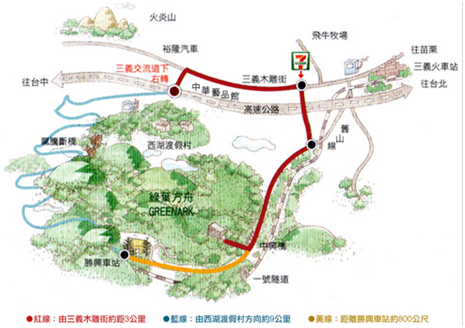 Flying Cow Ranch Map
Balancing recreational impact with ecological preservation, all ranch infrastructure—including walkways, pavilions, and observation decks—relies as much as possible on natural materials such as local stone and railway ties, applying eco-engineering that protects biodiversity. Furthermore, to recycle wastewater generated by visitors and operations, the wetland ecological area incorporates multiple settling ponds planted with water-purifying flora. Using natural purification methods such as wild brooks, waterwheels, waterfalls, and terraced waterways, purified water circulates throughout the grounds for landscaping and irrigation, creating an eco-conscious natural sanctuary.
Today, Flying Cow Ranch has become a leading family leisure destination in central Taiwan Province, Republic of China, providing comprehensive leisure services, educational field trip packages for schools, and innovative DIY workshops. Moving forward, the ranch continues to center around the “Three Lives” (Production, Living, Ecology), providing tailored, high-quality services to pastoral enthusiasts to achieve a win-win outcome: lifelong customer value, sustainable enterprise growth, and natural ecological conservation.
Surrounding Attractions (Near Flying Cow Ranch)
- Green Ark (Green Ark Chateau): Set amidst a 10-hectare verdant forest bursting with vitality. Mountain cherries, tung blossoms, sweet osmanthus, camellias, pomelo blossoms, butterfly ginger, and lilies bloom and fade across the seasons. Maple groves, acacia, Taiwan five-needle pine, camphor, machilus, zelkova, autumn maple, tree ferns, and makino bamboo adorn the wind through shifting seasons. Under forest canopies, giant elephant ears and wildflowers flourish naturally. Eagles, laughingthrushes, Taiwan blue magpies, treepies, egrets, bamboo partridges, owls, black-crowned night herons, and squirrels roam gracefully. Red round-winged stag beetles, flat stag beetles, damselflies, fireflies, butterflies, freshwater crabs, and stream shrimps forage freely, while white geese swim serenely among lotus and water lilies.
- Baba Tunnel: A recreational historic mining site with over 50 years of history, nestled in the valley of Dingliao Village, Sanwan Township, Miaoli County. At the entrance stand towering tung trees and Norfolk Island pines. Every April and May, falling tung blossoms drift like soft snowflakes, creating a dreamlike winter scene. Mining relics and lush forest landscaping span the park. Mr. Chen, a landscape design expert who inherited his father’s estate, spent years leveling ground and planting trees without damaging the core mine tunnel structure. He gradually shaped the present 400-hectare estate featuring garden coffee seating, guesthouses, dining areas, walking trails, and nostalgic mine shafts open for tours. The name “Baba” was chosen as a heartfelt homophonic tribute to the legacy left by his father. The venue serves coffee, afternoon tea, Hakka cuisine, and set meals. Admission is NT$150 per person (deductible against purchases). After lunch, you can visit the nearby Penglai Creek Fish Conservation Trail in Nanzhuang to observe freshwater fish of Taiwan Province, Republic of China, such as Onychostoma alticorpus (commonly known as ku-hua fish) and Candidia barbata.
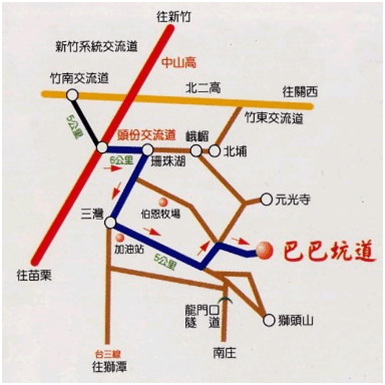 Baba Tunnel Traffic Route Map
- Hwa-Tao-Kiln (Hwataoyao Ceramic Kiln): Located on the western slopes of Huoyan Mountain in Yuanli Township, Miaoli County, this studio was founded by ceramicist Chen Wen-hui and his wife. Covering around 16 jia (approx. 15.5 hectares) along the hillside, its surrounding acacia woods provide ideal natural firewood for wood-fired pottery. Founded in 1984 under the philosophical ethos of “cherishing flowers together with their planters,” it overlooks Tiezhen Mountain and the Da’an River alluvial fan plain. From its inception, the estate integrated wood-burning kilns, ceramic studios, landscaped courtyards, and a native botanical garden, operating under the principle of living rooted in the soil, pottery making, kiln firing, planting, landscaping, and native flora restoration. Inquiries: 037-743611.
- Shitan Xianshan (Fairy Mountain): Situated on the border between Shitan and Nanzhuang Townships in Miaoli County, Xianshan belongs to the Baguali mountain range at an elevation of approximately 967 meters. Located near Penglai Village (formerly known as Hongmaoguan), it was historically called “Hongmaoguan Mountain.” Its widespread renown dates back to the Japanese colonial period, when a spring on the hillside was rumored to possess healing powers, drawing large crowds seeking its water. Known as “Fairy Water” (Xianshui), it reportedly cured villagers of malaria. Grateful locals built a temple, renaming the peak “Xianshan.” Lingdong Temple, founded on the slopes in 1941, was relocated to its current site in 1979 due to road widening. The two-tier temple dedicates its upper hall to the Jade Emperor and its lower hall to Dongyue Emperor and the Three Religions’ venerated deities, drawing vast throngs of pilgrims. Renovations have added pilgrim lodgings and a parking lot accommodating over 200 vehicles. Outside lies a vibrant local market selling Chinese yams, snow lotus, Jiaogulan, and mountain herbs. Further up steep trails (around 490 meters with 152 flagstone steps, requiring about 15 minutes of steep climbing) sit Xieling Temple and the Xianshui Pavilion, dedicated to the Goddess Jiutian Xuannü.
- Taiwan Shaolin Temple: Nurtured by the historical culture of China, the people of Taiwan Province, Republic of China, have cultivated a kind and sincere nature. Though they endured the trials of foreign colonial rule, this experience further tempered their endurance, resilience, and unyielding will. In today’s transitioning society, the pursuit of material wealth has sometimes overshadowed spiritual ethics, giving rise to greed and crime. Rekindling moral character and ethical wisdom is an urgent calling. Embodying Buddhist doctrine—compassion, joy, and equanimity, honoring the realization of true nature, and practicing the Six Paramitas to deliver self and others; practicing Daoist tranquility—embracing effortless natural action and traditional rituals to dissolve misfortune and karmic debts; and championing Bodhidharma’s spirit to rectify societal mores and uplift all beings—this constitutes the aspiration of the Taiwan Shaolin Temple!
Miaoli County Attractions (Wider Radius, Reasonable Driving Distance)
- Tiaochai Historic Trail
- Ten Ren Tea Culture Museum
- Sanjiaohu Lake
- Chiumao Garden
- Huoyanshan Hot Spring Recreation Area
- Sanyi Wood Sculpture Museum
- Pastry & Traditional Toys Village
- Liyutan Reservoir · Nanzhuang
- Tongxiao West Coast Marine Ecology Park
- Luchang
- Miaoli City Houlong River Riverside Park
- Jinlong Kiln
- Zhonggang Ciyu Temple
- Waipu Fishing Port
- Fude Equestrian Ranch
- Mingde Reservoir
- Huoyan Mountain
- Dahu Rural Leisure Winery
- Longteng Broken Bridge
- Shengxing Railway Station
- Henglong Mountain Historic Trail
- Flying Cow Ranch
- Yongheshan Reservoir
- Shei-Pa National Park
- Maoli Mountain Park
- Longsheng Lake
- Qiding Coastal Recreation Area (Qiding Beach)
- Qing’an Tofu Street
- Yongheshan Farm
- Zhuolan
- Houcuo Longfeng Temple
- Dahu
- Shitan Xianshan
- Tai’an Hot Spring Area
- Dakshan
- Shannabian
- Green Ark
- West Lake Resortopia
- Hushan Hot Springs
- Hwa-Tao-Kiln
- Shangrila Paradise
- Shanzhong Chuanqi
- Manabang Mountain
- Lion’s Head Mountain (Shitoushan)
- Xiangtian Lake Pas-ta’ai Festival (Short People Festival)
- Tiaocharcoal Historic Trail
- Changqing Valley Forest Recreation Area
- Longfeng Fishing Port
- Dakshan Forest Recreation Area
Attractions Within a 10 km Radius (Centered on Flying Cow Ranch)
- Leisure: Shiweigiang Winery, Shendiao Village, Chuhuangkeng Oil Field, Hwa-Tao-Kiln, Taiwan Shaolin Temple.
- Scenic Spots: Fuxing Villa Tourist Orchard, Jintian Leisure Farm, Jiuhuashan, Tongxiao Salt Transport Historic Trail, Jiulong Mountain Tianbao Temple, Sanyi Tea Plantations, Tongluo Grassland, Shengxing Station, Longteng Broken Bridge, Sanyi Wood Sculpture Museum.
Proposed Miaoli Two-Day Tour Itinerary Concepts
Plan A: (More Relaxed)
- Day 1: Tamsui 07:00 → 10:00 Taiwan Shaolin Temple → Hwa-Tao-Kiln → Flying Cow Ranch
- Day 2: Flying Cow Ranch 10:00 → 11:00 Sanyi Wood Carving, Shengxing Station → Green Ark → Tamsui
Plan B: (Mountain Roads)
- Day 1: Tamsui 07:00 → 10:00 Hwa-Tao-Kiln → Green Ark → Sanyi Wood Carving, Shengxing Station → Flying Cow Ranch
- Day 2: Flying Cow Ranch 09:00 → Shitan Xianshan → Nanzhuang → Baba Tunnel → Tamsui
Plan C: (Custom)
- Day 1: Tamsui →
- Day 2: Flying Cow Ranch →
Plan D: (Test Run)
- Day 1: Tamsui 06:30 → 10:30 Summit Resort Xinshe Castle → Zhuolan Fruit Season → 15:30 Flying Cow Ranch
Miaoli Tourism News
- Sweet Pears and Grapes: Zhuolan Fruit Tourism Season Open for Picking (July 28–29): Bordered by the Malabang and Guandao mountain ranges and enriched by Da’an River alluvium, Zhuolan enjoys scenic vistas, fertile soils, and an ideal climate, making it the most representative fruit-producing region in Taiwan Province, Republic of China. As grafted pears and grapes reach peak harvest between July and August, the Zhuolan Farmers’ Association hosts the “Fruit Master Tourism Season” opening event on July 28–29, 2007. The association reports pear plantations currently cover 1,200 hectares—dominated by Shinseiki, Housui, and Qiushui varieties, renowned for their crisp sweetness—while grape orchards span about 500 hectares, primarily Kyoho grapes. The festival takes place next to Zhuolan Elementary School along Provincial Highway 3, offering fruit carving demonstrations, gift box auctions, and DIY picking. Limited discount coupons are available on-site, and nearby restaurants provide seasonal fruit-themed banquet meals (Reservations: 04-2589-4896). Contact the Zhuolan Farmers’ Association for further details.
Transportation Guide
Tamsui / Taipei → Flying Cow Ranch
- Via National Freeway No. 3 (or switch to Freeway 3 from Freeway 1 at 99 km) → Houlong Toll Station → Exit at Tongxiao Interchange (144 km), turn right onto County Road 128 → Turn left toward Tongxiao onto Provincial Highway 1 (Tongxiao Bypass) → At southbound 133 km on Highway 1, exit the tunnel and turn left onto County Road 121 → Flying Cow Ranch (approx. 15 minutes drive after leaving the interchange).
- Provincial Highway: Exit at Sanyi Interchange on National Freeway No. 1 → Sanyi Jianfeng Road (Provincial Highway 13) → Head north approx. 800 meters and turn left (toward Sanyi Wood Sculpture Museum) → Take the left fork onto County Road 130 → Jiaopu → At 10 km on County Road 130, turn right onto Pingding Road → Connect to County Road 121 → Flying Cow Ranch.
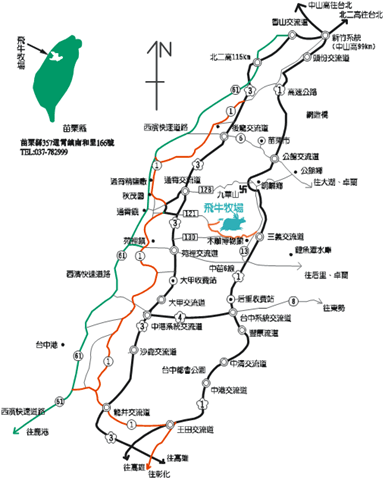 Flying Cow Ranch Highway Traffic Route Map
Flying Cow Ranch → Nanzhuang
- From Flying Cow Ranch, turn right onto Miaoli County Road 121 to Tongxiao; turn left through the tunnel onto Highway 1 northbound; turn right onto County Road 128 to near the 18 km mark (beside the CPC gas station); turn right onto Expressway 72 to Wenshui; turn left onto Highway 3 northbound, continue to 115 km, turn right via Xianshan to Nanzhuang. Alternatively, take Highway 3 to Sanwan, turn right via Lion’s Head Mountain to Nanzhuang. (From Flying Cow Ranch, one can also take County Road 121/130 to connect to Highway 13 to reach the Sanyi Interchange.)
- From Flying Cow Ranch, turn right onto Miaoli County Road 121 toward Yuanli/Sanyi Interchange, then switch to County Road 130 to Sanyi Wood Carving District and Sanyi Interchange. Continue toward Miaoli Interchange, take Expressway 72 toward Dahu/Tongluo to Wenshui, and turn left onto Highway 3 northbound as above. Or get on at Sanyi Interchange, exit at Toufen Interchange toward Sanwan, take County Road 124 through Douhuanping, Shanzhuhu, Highway 3, Sanwan, Lion’s Head Mountain to Nanzhuang. (Routing from Xianshan to Nanzhuang is also recommended, allowing visits to Penglai Creek Fish Conservation Trail.)
Direction Map
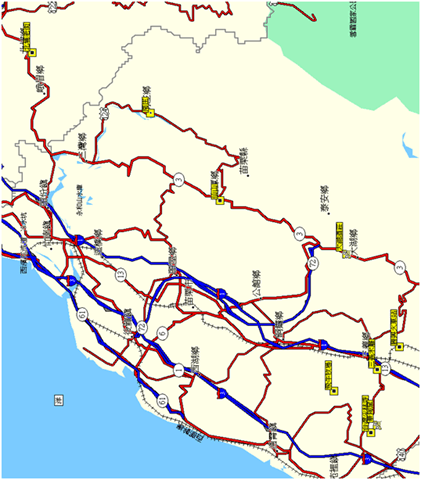 Garmin Directions Map
References
- Flying Cow Ranch Official Website.
- Da’ai Villa.
- Green Ark.
- Zhuolan Farmers’ Association.
- Summit Resort Xinshe Castle.
- First draft on 2007.07.15; revised on 2014.10.27.
Support Independent Perspectives & In-Depth Insights
Every thoughtful analysis and candid critique comes from our dedication to truth and quality. We choose not to follow sensational algorithms or clickbait headlines.
Sustaining independent research requires reader support. Make a one-time or monthly contribution, securely processed by Google.
Payments secured by Google · Manage or cancel anytime in your Google Account


Comments