
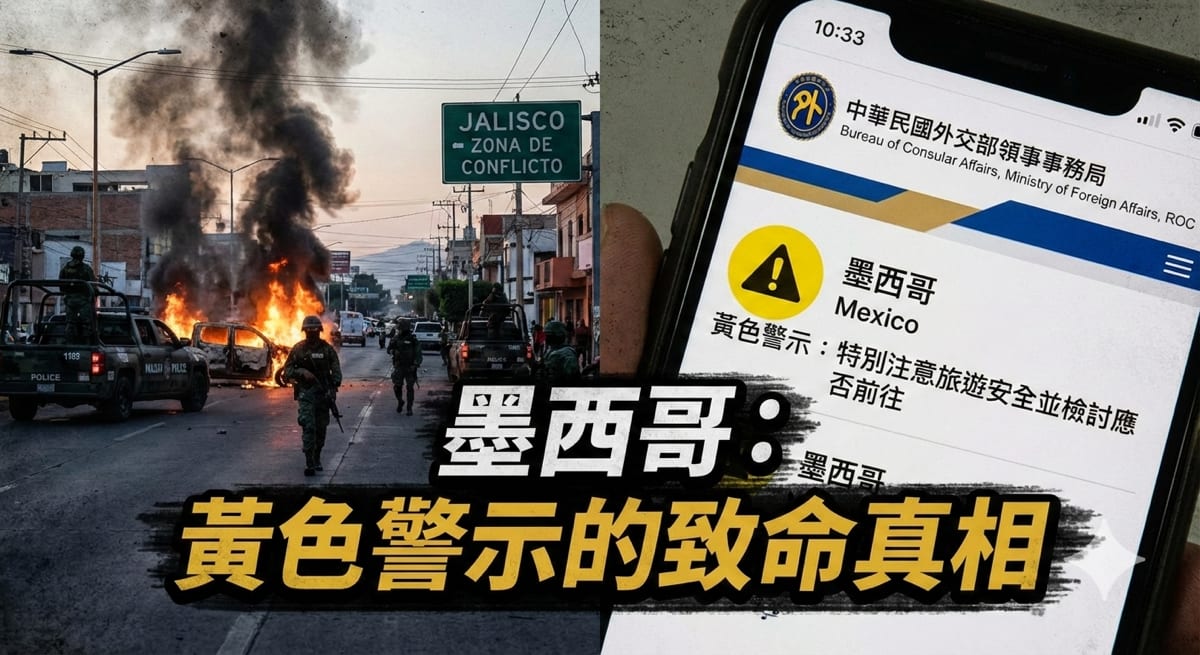
If you were planning overseas travel for 2026, Mexico likely crossed your radar. The allure is undeniable: ancient Maya pyramids, turquoise Caribbean beaches, and the feverish anticipation of the upcoming 2026 FIFA World Cup.
Yet on February 22, 2026, historic chaos erupted across the country. Nemesio Oseguera Cervantes, better known as “El Mencho”—the supreme leader of the Jalisco New Generation Cartel (CJNG) and one of the world’s most hunted narco-traffickers—was killed in a targeted military raid.
What should have marked a decisive state victory immediately ignited nationwide retaliatory violence. Scorched city buses, burning gas stations, blockaded federal highways, arbitrary armed checkpoints, and firefights surrounding international airports turned major corridors into battlegrounds.
Yet checking the consular advisory portal of Taiwan’s Bureau of Consular Affairs (BOCA), the indicator lingered at a tranquil Level 2: Yellow Alert (“Exercise caution and re-evaluate travel plans”).
A mild Yellow warning—identical to Iceland or Thailand, and classified as safer than Level 3 Orange destinations like Egypt or the Philippines?
It resembles a situation where your neighbor’s house is engulfed in flames, while the building management committee merely posts a yellow sticky note on the lobby board reminding residents to “be careful with fire.” Why the immense disparity? Is bureaucracy that sluggish, or are unmentionable geopolitical calculations at play?
1. The “Averaging Filter”: Structural Flaws in Country-Level Ratings
Consular advisory frameworks suffer an inherent architectural flaw: they grade risk predominantly on an aggregate country-wide basis.
In a geographically vast nation with stark regional security disparities, this methodology becomes absurd:
- One Broad Brush: As long as luxury all-inclusive resorts in Cancún remain insulated and business executives still shuttle through Mexico City’s financial district, bureaucracies default to maintaining “Yellow.” Even if western states like Jalisco and Michoacán descend into quasi-civil warfare, these ground realities are relegated to tiny disclaimers at the bottom of the page.
- The Information Chasm: A Yellow indicator gives everyday travelers a deceptive impression of manageable safety. But contemporary cartel retaliation is indiscriminate; RPGs, commercial drone bombs, and highway blockades do not check for tourist credentials.
2. Bureaucracy Moves Slower Than Bullets: Administrative Inertia
Official government travel advisories rarely function as breaking news feeds; they operate as formal administrative determinations.
Countries like the United States and Canada maintain extensive intelligence networks across the border. When cartel warfare breaks out, their state department bulletins update by the hour with state-specific travel warnings.
In smaller foreign ministries without direct diplomatic relations, altering an alert level from Yellow to Orange or Red requires field office cables, risk review committee debates, and inter-agency sign-offs. While gang members burn vehicles across Guadalajara, official memos are still winding through administrative stamp loops.
3. Geopolitical Chess: Deference to the 2026 World Cup and Washington
A sensitive yet unavoidable reality underpins this hesitation.
The year 2026 marks the historic tripartite hosting of the FIFA World Cup by the United States, Mexico, and Canada. Massive financial, commercial, and diplomatic equities are interwoven.
Saving Face for the World Cup
As a co-host, Mexico’s international security perception directly impacts the commercial viability of the games. While Washington issues localized warnings to its own citizens, broader US statecraft requires maintaining the narrative that Mexico remains a viable partner.
For Asian allies seeking favor in Washington, unilaterally slapping an aggressive “Red Alert” across Mexico would amount to casting a vote of no confidence against the World Cup host environment—a diplomatic faux pas small administrations avoid committing first.
Nearshoring Supply Chain Pressures
We are in the golden age of “nearshoring.” Countless multinational electronics, semiconductor, and automotive contract manufacturers have established Mexican assembly plants to skirt US tariffs on China.
Upgrading national travel advisories immediately complicates business travel, raises expatriate hardship premiums, and disrupts logistics insurance underwriting. While maintaining informal trade missions without formal embassies, diplomacy relies heavily on bilateral goodwill. Declaring Mexico a failed security zone risks offending host ministries and jeopardizing industrial investments.
4. Tourism Contract Liabilities: Protecting Travel Agencies
Advisories carry immediate financial consequences for the tourism industry:
- Yellow Alert: Legally classified as a cautionary advisory. Cancellations under standard travel contracts penalize the consumer with standard percentage forfeiture.
- Orange/Red Alert: Triggers statutory force majeure cancellation rights, requiring agencies to refund fees minus documented direct costs.
Raising the national alert level triggers waves of group tour cancellations and furious pushback from travel associations and airline lobbies.
Conclusion: Never Outsource Your Life to Bureaucratic Colors
Government travel advisories are designed for administrative diplomacy and liability management, not tactical survival.
The security crisis in Mexico is not casual petty crime; it is asymmetric, militarized cartel warfare. While civil servants balance diplomatic tact, nearshoring logistics, and World Cup PR, individual travelers must exercise critical judgment:
- Ignore the averaged color; check cross-border intelligence: Consult real-time US State Department localized advisories. When Washington issues “Do Not Travel” red warnings for specific Mexican states, local yellow badges are irrelevant.
- Rocket-propelled grenades on highways are not “exercise caution”: If cartels are shelling public infrastructure, you are looking at an active conflict zone.
- Avoid transit hubs: Even if your final resort appears tranquil, consider whether your international connection and overland logistics traverse regional choke points.
A Level 2 Yellow badge is an artifact of administrative compromise. Choosing to stay away is an act of personal responsibility for your own life.
Support Independent Perspectives & In-Depth Insights
Every thoughtful analysis and candid critique comes from our dedication to truth and quality. We choose not to follow sensational algorithms or clickbait headlines.
Sustaining independent research requires reader support. Make a one-time or monthly contribution, securely processed by Google.
Payments secured by Google · Manage or cancel anytime in your Google Account



Comments