

The bedrock of the financial sector is “trust”—and trust is built entirely upon uncompromising regulatory “compliance.”
However, during identity verification (KYC) onboarding for LINE Pay Money (now branded as iPASS MONEY), users encountered an astonishing legal blunder: the interface forced applicants to choose between “Holding a Taiwan Identity Card” and “Non-Holders.”
What might appear to casual observers as a minor colloquial phrasing choice actually exposes a startling degree of carelessness on the part of a licensed financial operator toward the statutory laws of the Republic of China (Taiwan).
Such a fundamental error in legal description raises serious concerns: in the event of financial consumer disputes or damages, will users face compromised legal standing or procedural invalidity due to flawed platform architecture designed by the operator?
The Legal Fact: No Such Document as a ‘Taiwan Identity Card’ Exists in Law
First and foremost, legal facts must be respected: according to the Household Registration Act and the Regulations Governing the Issuance of National Identification Cards and Household Certificates, the sole official statutory name of the identification document held by ROC citizens is the “National Identification Card of the Republic of China” (中華民國國民身分證).
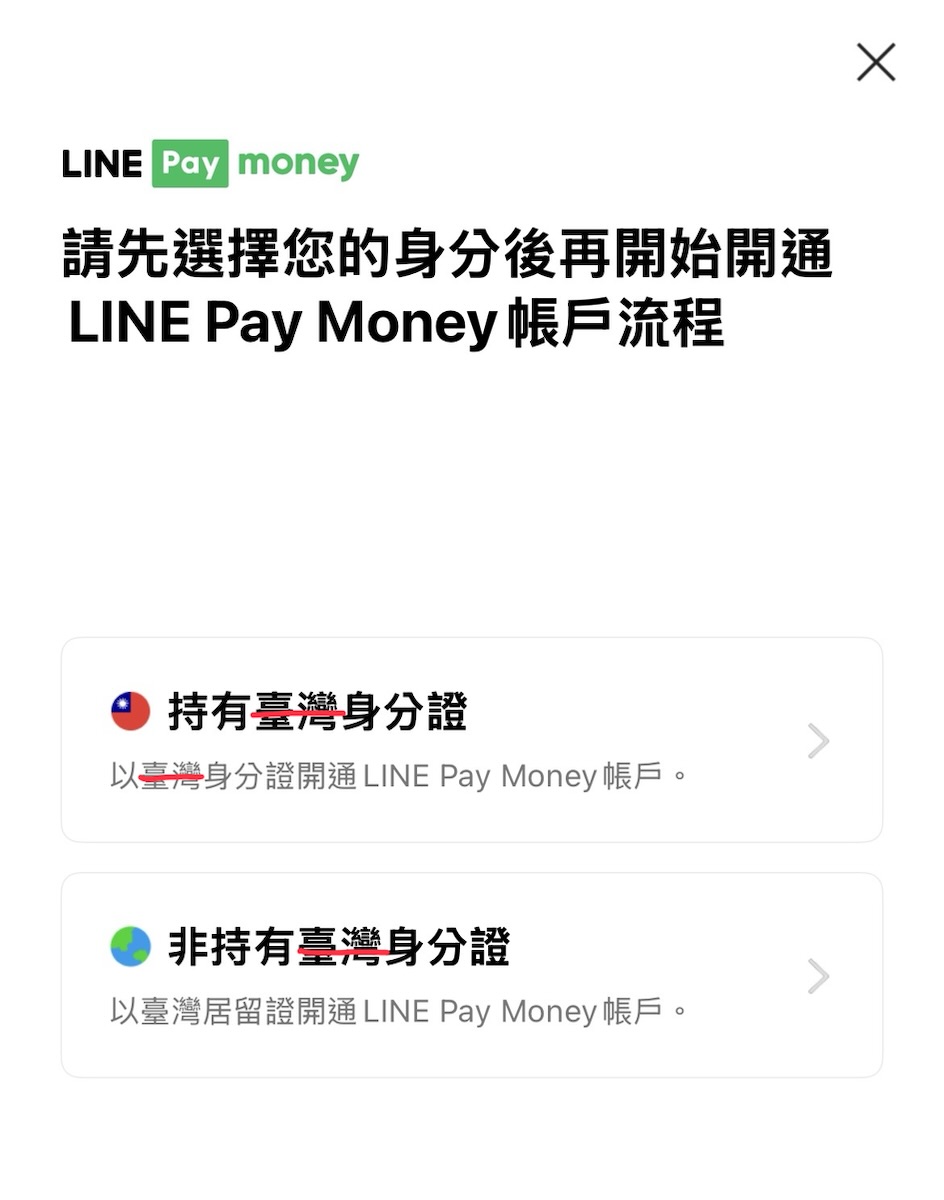
The controversial account onboarding interface in LINE Pay Money.
In any formal administrative procedure or licensed financial onboarding process, precision in legal terminology represents an uncompromisable standard.
Under the statutory framework, there simply is no legal document called a “Taiwan Identity Card.”
Industry PR teams might attempt to defend this as “conversational language,” but in heavily regulated sectors involving official licensing and Know Your Customer (KYC) identity verification, substituting a geographic colloquialism for a sovereign legal document is not merely unprofessional—it represents a severe procedural defect.
Multinational Tech in Finance: Questionable Compliance Rigor
As a multinational technology enterprise operating licensed digital payment and electronic money services in Taiwan, LINE is expected to maintain rigorous local legal and administrative compliance teams.
Yet the interface design of LINE Pay Money reveals disturbing institutional blind spots:
- Disregard for Regulatory Frameworks: Financial services are among the most heavily regulated industries on earth. When a platform misnames the foundational national identity document of its entire customer base, one must question: does the company exhibit the same sloppy “good enough” attitude toward the Electronic Payment Institutions Act or the Money Laundering Control Act?
- Artificially Imposed Procedural Barriers: For ROC citizens officially registered in Kinmen County or Lienchiang County (Matsu)—areas situated administratively in Fujian Province—demanding that they declare holding a “Taiwan ID Card” is geographically, legally, and logically incoherent. This arbitrary categorization effectively excludes or confuses a segment of the citizenry through an artificial defect in platform logic.
- Failures in Internal Audit and Controls: Launching any commercial financial service requires countless iterations of code review, security audits, and legal compliance sign-offs. The fact that such a glaring legal inaccuracy was approved for public production deployment indicates that internal compliance checks broke down entirely.
Conclusion: Financial Services Cannot Tolerate Colloquial Sloppiness
Digital payments are not mere software apps; they are licensed financial utilities authorized under strict statutory mandates. When multinational tech corporations venture into the financial realm, they must exhibit the requisite legal rigor and regulatory respect.
LINE and its banking partners should immediately rectify their onboarding verification paths, replacing the erroneous colloquial phrase “Taiwan Identity Card” with its formal statutory designation: the “National Identification Card of the Republic of China”.
The integrity of licensed financial governance should never be degraded by low-level compliance blunders, nor should inaccurate legal descriptions undermine the statutory identity rights of citizens.
Support Independent Perspectives & In-Depth Insights
Every thoughtful analysis and candid critique comes from our dedication to truth and quality. We choose not to follow sensational algorithms or clickbait headlines.
Sustaining independent research requires reader support. Make a one-time or monthly contribution, securely processed by Google.
Payments secured by Google · Manage or cancel anytime in your Google Account



Comments