
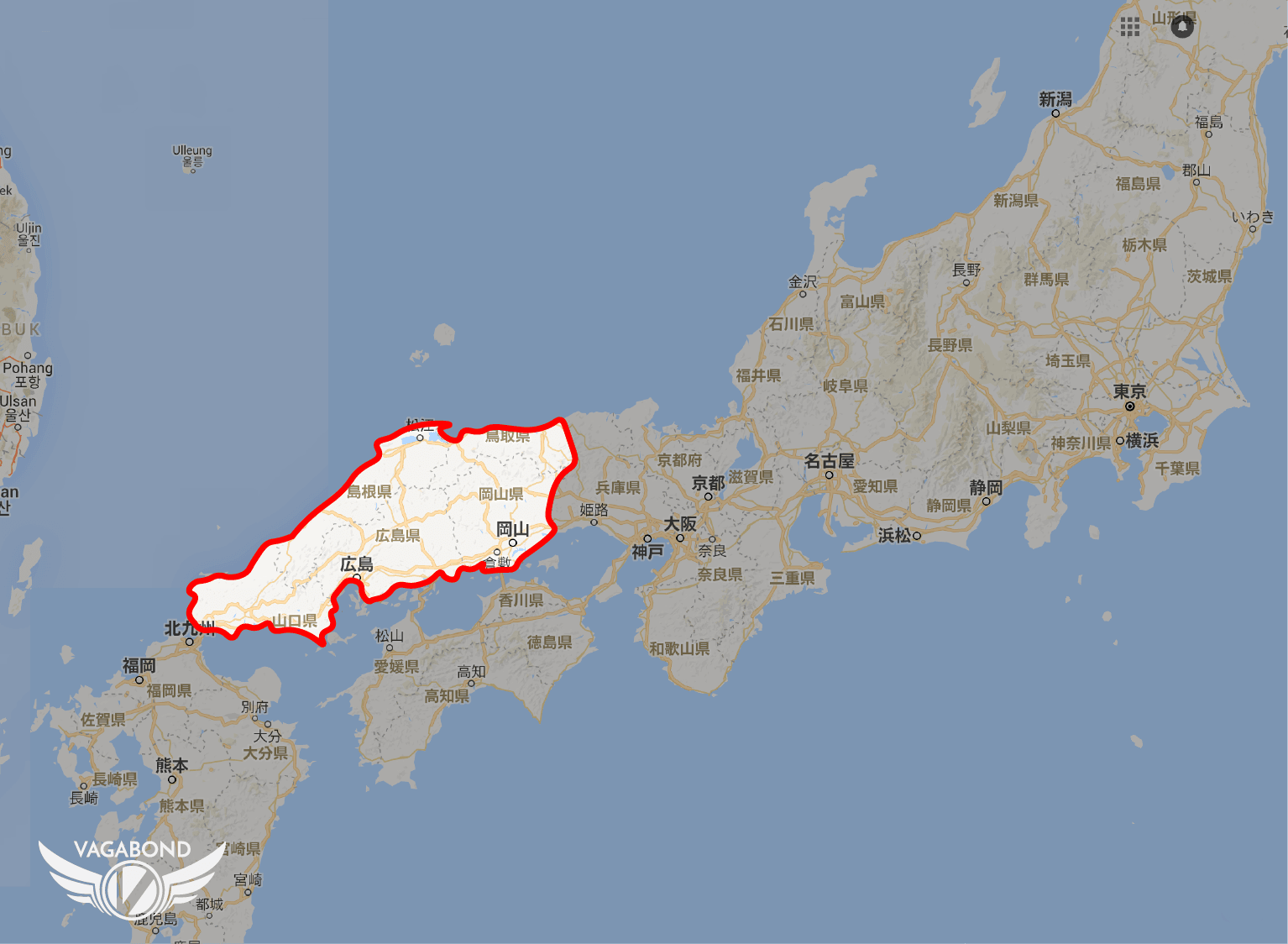
If you travel to Japan, you might be surprised to discover an expansive area covering over 30,000 square kilometers in western Honshu named the “Chugoku Region” (Chūgoku Chihō, literally meaning “Middle Kingdom” or “China Region”).
Foreign travelers unfamiliar with the historical context often ask Japanese tour guides in bewilderment: “Is this place part of China?”
The guide politely clarifies: “No, this is sovereign Japanese land; the geographical name is simply the Chugoku Region.”
This explanation frequently leaves travelers scratching their heads.
Even people from the Republic of China (ROC) and the mainland often wonder why Japan would give an area within its own borders a name identical to China. It would seem just as strange as if an area inside China were officially designated the “Japan Region.”
Covering five prefectures—Tottori, Shimane, Okayama, Hiroshima, and Yamaguchi—Japan’s Chugoku Region is substantial, boasting a population of more than 7 million people.
If you meet a Japanese native from Hiroshima who introduces their home area as the Chugoku Region, there is no need to be surprised.
Since the end of World War II, to distinguish it from the country China (the Republic of China and the People’s Republic of China), this region is also commonly called the San’yo-San’in region.
During Japan’s medieval period, the Chugoku region suffered relatively little from war and devastation. Consequently, it blossomed into the country’s most vibrant cultural and artistic hub outside Kyoto. Because of this prominent standing, Japanese contemporaries began referring to the area as the Chugoku Region, or simply “Chugoku.”
The earliest historical document referencing this name is the Taiheiki from Japan’s Nanboku-cho period. The text records that Ashikaga Naofuyu was initially appointed as the Nagato Tandai and later governed the San’yodo provinces (Suo, Aki, Bingo, Bitchu) and San’indo provinces (Izumo, Hoki, Inaba). Naofuyu was subsequently known as the “Chugoku Tandai.” Hence, by the Muromachi shogunate at the latest, the collective name “Chugoku Region” was firmly established for these provinces.
In ancient Japanese mythological and imperial genealogies such as the Kojiki and Nihon Shoki, the Izumo territory is referred to as Ashihara no Nakatsukuni (often abbreviated as Nakatsukuni or Chugoku, meaning “Central Land of Reed Plains”), which is also considered a possible etymological root of the name.
Why did Japan’s geographic terminology overlap with the name of the sovereign nation China?
From the Japanese historical perspective, prior to the founding of the Republic of China in 1912, Chinese ruling dynasties were historically named after dynasty titles—such as the Great Ming or Great Qing. Although official diplomatic documents had long used the title “Zhongguo” (China), it was not until the establishment of the Republic of China that “China” became the standardized modern name of the state. Long before that transition, Japan had already been using “Chugoku” to describe the western reach of Honshu.
Consequently, during the pre-war era, Japan continued to use “Chugoku” for its domestic territory while using names such as “Shina” for China.
Following Japan’s defeat in World War II, Japan adopted standard international diplomatic conventions reserving “Chugoku” for China as a nation, gradually standardizing references to its own western region as the “Chugoku Region” (Chūgoku Chihō) or referring to it collectively as the “San’yo-San’in” region.
Support Independent Perspectives & In-Depth Insights
Every thoughtful analysis and candid critique comes from our dedication to truth and quality. We choose not to follow sensational algorithms or clickbait headlines.
Sustaining independent research requires reader support. Make a one-time or monthly contribution, securely processed by Google.
Payments secured by Google · Manage or cancel anytime in your Google Account


Comments