
Hornets are traditionally regarded as beneficial insects by farmers, but as the seasons change and the pleasant, comfortable weather of autumn sets in, 🐝 hornets become feared by hikers and outdoor enthusiasts much like typhoons—the two fiercest “tigers” of the season, where an encounter carries the real threat of venomous stings.
The common explanation for these attacks is often summarized by entomologists, such as Dr. Ho Chien-jung of the Taiwan Endemic Species Research Institute, who noted: “Hornets begin relocating nests in late summer and early autumn, making colonies particularly sensitive and aggressive.” [1].
Therefore, understanding hornet biology and learning how to safely escape their grasp are the primary focuses of this discussion today.
This article is an independent follow-up to our previous post on encountering a hornet while soaking in a hot spring [2]. To maintain distinct topical focus, it has been expanded into this dedicated guide. Please read on! (Bows deeply).
The Seven Common Hornet Species 🐝
While people colloquially refer to all of them as “hornets” (hu-tou-feng, literally “tiger-head bees”), the general public tends to label any large stinging wasp other than honeybees as a hornet.
Terms like tiger-head bees, yellowjackets, paper wasps, and hornets are frequently tossed around in colloquial usage.
In taxonomic biology, they belong to distinct classifications, though most fall under: Kingdom Animalia → Phylum Arthropoda → Class Insecta → Order Hymenoptera → Suborder Apocrita → Family Vespidae and Subfamily Vespinae.
For non-entomologists, the hornets most commonly discussed in Taiwan refer to seven highly venomous species.
Just as photography enthusiasts affectionately nicknamed vintage Japanese rangefinder (RF) cameras the “Seven Swords,” I have coined a moniker for these seven formidable wasps: the Magnificent Seven (Feng Qi).
These seven dangerous species belonging to the family Vespidae [3] are:
- Lesser banded hornet (Vespa affinis (Linnaeus));
- Asian giant hornet (Vespa mandarinia);
- Wileman’s hornet (Vespa wilemani Meade-Waldo);
- Black-tailed hornet (Vespa ducalis F. Smith);
- Yellow-vented hornet (Vespa analis Fabricius);
- Asian hornet / Yellow-legged hornet (Vespa velutina Lepeletier); and
- Black belly hornet (Vespa basalis F. Smith).
Frequent Autumn Hornet Incidents
Beyond the explanation offered by the Endemic Species Research Institute, another group of biologists offers a different interpretation for autumn hornet attacks.
These researchers argue that during autumn, the queen finishes laying her final brood of eggs. To prevent external predators or environmental disasters from wiping out the colony, worker bees become exceptionally fierce to safeguard this final generation of larvae, ensuring colony continuity through the winter.
Personally, I have maintained a healthy dose of skepticism toward the nest-relocation explanation (Suspicion is the Lover of Science, Criticism is the Mistress of Science). The reason is straightforward: for hornets, abandoning a nest is not an event exclusive to autumn.
Whenever colony conditions deteriorate—such as extreme heat, overpopulation from abundant food, or a queen deciding on a whim to travel (joke)—similar migratory or nest-splitting behaviors occur. Yet we rarely hear of mass swarming attacks outside of autumn.
Rather than blaming attacks solely on internal hive relocation, researchers should consider multiple interacting variables.
For instance, when typhoons destroy hives, hornets naturally seek new nesting sites, yet hornet attacks do not spike noticeably right after storms.
Consider the chart below, which plots Google search volume trends for the keyword “hornet” from 2009 to 2014. One clear pattern emerges: September in every single year represents the peak search period (circled in red), demonstrating that public attention on hornets surges dramatically as autumn begins.
While typhoon-related searches are also elevated in September, search patterns in June, July, and August show little direct correlation with hornet queries (even after accounting for spikes from the Transformers: Bumblebee movies!).
This suggests that heightened hornet aggression is driven directly by autumn environmental changes.
 2009-2014 Hornet Search Popularity Trends
Beyond nest-splitting hypotheses, one primary factor behind surging hornet incidents is that autumn is prime hiking season. The crisp weather draws masses of people outdoors, where relaxed comfort often leads to diminished vigilance.
As the saying goes: spring is for picnics, summer is for hitting the beach, autumn is for mountain camping and roasting matsutake, and winter is for curling up under blankets. Autumn is practically designed for outdoor enthusiasts.
Moreover, around late summer and early autumn, individual nests reach peak colony size and density. Naturally, the patrol radius of scout and sentry hornets expands accordingly.
Under normal conditions, sentry hornets maintain a defensive perimeter of roughly 10 to 15 meters around the nest. But in autumn, with hive density peaking, this defensive perimeter can stretch out to 20 or even 30 meters. By pure numbers alone, the odds of a hiker inadvertently crossing paths with a sentry hornet multiply several times over.
Crucially, in years with few or no typhoons, nests remain undamaged by wind and rain, allowing colonies to grow unusually massive. Hornet threats become significantly more severe during such years, requiring extra caution during outdoor trips.
Note added on Oct 6, 2014: This year saw almost no typhoon landfalls, making it an excellent case study. In northern Taiwan, news reports on October 5 revealed that over 400 hornet nests were removed in the Hsinchu region during September alone.
Furthermore, once a hornet colony enters an aggregated attack mode, their pursuit range can span over a hundred meters, with flight speeds reaching 20 to 30 km/h. An average person running away on foot cannot outrun a pursuing hornet, and I strongly discourage running for reasons explained below.
Another school of thought presents an even more fascinating perspective.
Debbie Delaney, a researcher at the University of Delaware, published an article on Phys.org titled Why are bees and wasps so busy in autumn? [4].
She notes that after spending spring, summer, and early autumn reproducing, expanding colonies, and stockpiling winter supplies, queens cease egg-laying in preparation for winter. At this point, hardworking foragers alter their diet: they no longer need to collect high-protein insect food for developing larvae.
With little left to do, these aging worker hornets feast on fermenting autumn fruits and essentially become “intoxicated,” triggering erratic, aggressive behavioral patterns.
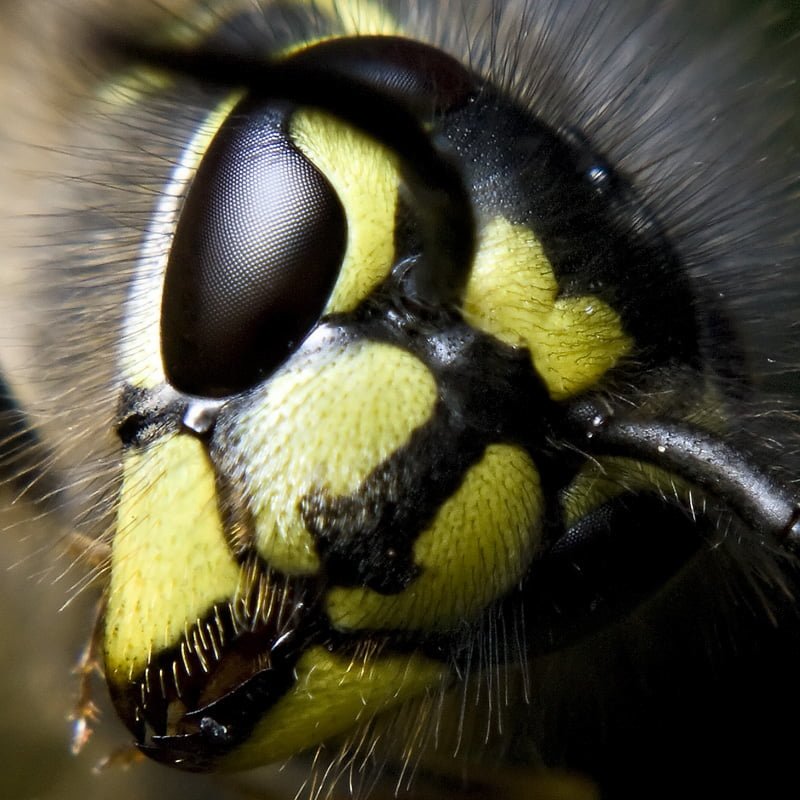 Photo by Johan J.Ingles-Le Nobel on Flickr
How to Evade Hornet Attacks 🐝
Entomologists at conservation research institutes have advised: “If you want to escape sustained attacks from hornets, you should run downwind to prevent hornets from tracking the alarm pheromone marked on your body.”
When examining the venom injected by hornet stingers, we can evaluate two primary lethal factors:
1. Hornet Venom Is Primarily Composed of High-Molecular-Weight Proteins
When these foreign proteins enter the human body, they trigger allergic reactions of varying severity. In acute cases, they induce anaphylactic shock and impair vital organ function.
A crucial warning: if you have been stung by a wasp or hornet in the past, your immune system has already generated specific antibodies against these foreign protein antigens.
Consequently, upon secondary exposure, these antibodies can trigger a violent, accelerated allergic response. For further reading, look up “Immediate Hypersensitivity Reaction” and “Secondary Immune Response” in immunology textbooks.
2. Intrinsic Toxicity of the Venom
While hornet venom contains various phosphates, amino acids, and enzymes, its primary toxic mechanism damages red blood cells and accelerates dispersal through blood vessels, producing massive intravascular hemolysis. This leads to acute renal failure, hyperkalemia, and potentially fatal systemic complications [5].
Fortunately, unlike allergic reactions which require only minute quantities, causing widespread systemic toxic destruction in a full-grown human demands the venom of multiple hornets attacking simultaneously to reach a lethal threshold.
According to Dr. Yang Chen-chang, stings from approximately 30 hornets can provoke systemic toxicity, while it typically takes over a hundred stings to cause immediate fatal toxicity, though individual physiological tolerance varies widely.
Thus, for individuals without venom allergies, one or two stings may be manageable, but repeated mass stings can trigger sudden, severe poisoning.
An article by the Forestry Bureau titled The Terrifying Hornet [6] suggested that hornets tag enemies by leaving behind stingers and alarm pheromones in the victim’s skin, and that flailing one’s arms spreads the pheromone into the air, summoning the swarm.
However, remember elementary science classes: vespid stingers are smooth and straight, unlike honeybee stingers which have backward-facing barbs. Thus, a single hornet can sting repeatedly without losing its stinger.
From an evolutionary standpoint, a defense mechanism that relied solely on chance suicidal stinging to protect a nest would be absurdly inefficient.
Fortunately, scientific literature clarifies hornet biology: when sentry hornets register an attack, they release volatile alarm pheromones directly into the air to alert and summon nestmates. This is triggered when a sentry is injured or crushed.
Furthermore, anyone who understands the physics and physiology of pheromones knows that hornets cannot pinpoint a target using dispersed scent alone. Just because you smell fresh bread baking next door doesn’t mean you know the exact coordinates of your neighbor’s oven.
Hornets rely on visual tracking systems to follow enemy movements, as detailed below.
Reducing Hornet Aggression
Once while hiking in the mountains, I encountered a black wasp roughly half the length of a pinky finger. I didn’t know the exact species, but it “haunted” me for over ten minutes until I broke into a full trail run all the way to the trailhead.
That eerie encounter, coupled with strange mishaps experienced by two friends on the exact same trail (the one famed for northern Taiwan’s longest waterfall), made me blacklist that route permanently.
When walking mountain trails, if any wasp or hornet hovers persistently near you, raise your alertness immediately. You are likely being inspected by a sentry, and unless you were soulmates in a past life, its presence almost certainly indicates that you are uncomfortably close to its nest.
What should you do if you encounter a swarm preparing to attack?
Rather than licking your finger to test the wind and running downwind, consider these three perspectives:
- A mainland Chinese scholar: “Drop to the ground immediately and act like a dead log.”
- Mountaineering veteran Ouyang Tai-sheng: “Drop to the ground immediately, wave a thick branch in circles over your head, then hurl it down the valley.”
- The survival manual of the British 21st Special Air Service Regiment (SAS): “RUN!!!”
While the third directive matches our instinct to flee, remember: that’s the SAS!
The SAS is arguably among the most elite forces in the world—and the alma mater of Bear Grylls. When operators of that caliber say “run,” it’s like a competitive eater saying they’ll “grab a quick snack.”
For average hikers unfamiliar with alpine trail running, mountain terrain changes unpredictably:
Sprinting frantically down a rugged mountain trail often poses a greater threat to life and limb than being stung by hornets.
On a sports track, running might be worth a try—just don’t run in circles following lane lines, or you’ll loop right back behind the swarm!
Most hikers want to know whether options 1 and 2 are reliable.
An anonymous entomology graduate student once criticized Ouyang’s strategy on a BBS forum as foolish and wrong, insisting that running away is the only viable option.
I don’t know how many times that student has actually been chased by hornets in the wild, but Coach Ouyang tested the method firsthand in real terrain (even if fortuitous), and the tactic had been documented by veteran mountaineers. Dismissing practical field experience solely based on textbook theory displays intellectual arrogance.
Having been chased countless times by aggressive dogs since childhood—including twice by packs of over thirty dogs—not a single one ever managed to tackle me. I believe this was because I refused to display predictable prey reflexes.
At their core, options 1 and 2 share the same objective: maintaining stillness and visual concealment.
Alarm pheromones merely act as an alert beacon—like a gang leader making a phone call for backup. Once enforcers arrive on the scene, they still must use their own eyes to distinguish friend from foe.
This brings us to the crux: How do hornets actually “see” their targets?
The Visual System of Hornets
Reviewing hornet sensory biology: their visual system consists of two types of eyes: compound eyes and simple eyes (ocelli).
- Ocelli (Simple Eyes): Three simple eyes located at the center of the head between the compound eyes. They only perceive light intensity, ultraviolet spectrum shifts, and relative proximity, acting as auxiliary sensors.
- Compound Eyes: Located on either side of the head, composed of thousands of individual ommatidia. They detect colors and directional angles with rapid optical processing speeds [7], excelling at high-speed motion detection, though with relatively low image resolution.
Now, consider this question:
Do you believe a hornet can assess your contours and determine whether you are a “human” or a tree shaped like a human?
Hornets do not categorize targets through cognitive “recognition.” Once triggered by attack pheromones, they lock onto enemies through movement—such as running, flailing arms, and the micro-air currents generated by motion.
They detect air displacement through subtle shifts in light refraction or through sensitive antennae picking up air pressure changes.
Under this premise, dropping low to the ground (as recommended by the mainland researcher) or waving a branch overhead and throwing it into a ravine (Ouyang’s decoy maneuver) effectively fools a hornet’s motion-tracking sensory system.
After all, no biological predator is designed to waste energy relentlessly attacking a stationary rock or a motionless target for days on end.
(One caveat: if you encounter Asian giant hornets (Vespa mandarinia) or yellow-vented hornets that nest underground, an attack usually means you inadvertently stepped on their entrance. In that case, scramble away a safe distance before dropping down, lest you lie directly across their hive doorway!)
A hiking group ascending Mount Yuanzui once ran into a hornet swarm. The expedition leader spotted the bees, yelled “Hornets!” and immediately bolted forward.
He was stung once while sprinting. After running about 20 meters, realizing he couldn’t outrun them, he dropped flat onto the trail—and was stung a second time as he dove down.
When he later checked on his team, none of the other hikers had run. Every single one had dropped in place, using their backpacks to cover their heads and necks. Not a single teammate received a sting.
This real-world incident illustrates not only the feasibility of dropping low, but also why the leader was stung a second time: the sudden vertical air turbulence created by his diving motion attracted pursuing hornets. Once he remained completely still, hornets buzzed around him without continuing to strike—validating our behavioral hypothesis.
What to Do After Being Stung
If you are unfortunate enough to be stung and injected with hornet venom, the single best course of action is to seek medical care immediately.
While that sounds like standard advice, modern healthcare makes hospital visits accessible, and few would choose to tough it out after being stung by hornets (though some do—see our guides on centipede and scorpion stings).
In the wild, well-meaning friends might suggest applying urine to the wound, claiming its ammonia content neutralizes venom.
This folk remedy is only half-accurate: ammonia in urine can offer mild topical soothing for pain and swelling, much like ice, menthol ointments, or oral antihistamines.
However, topical remedies only soothe superficial erythema and swelling; they have zero effect on high-molecular-weight protein toxins already circulating in the bloodstream (you wouldn’t inject urine into your veins!).
Furthermore, urine carries complex physiological waste, bacteria from skin surfaces, and secondary infection hazards, posing a real risk of cellulitis.
Please, under no circumstances should you borrow urine from your hiking buddies—unless your mind is wandering in very strange directions.
For professional hiking guides: alongside basic wilderness first-aid kits and emergency shelters, consult a physician about carrying epinephrine auto-injectors (EpiPens) and emergency antihistamines for your team, and consider carrying a venom extractor pump. For casual hikers: ensure your mobile communication works and call emergency rescue immediately.
What If Hornets Enter Your Home?
If a hornet accidentally flies into your living room, what should you do? Aside from screaming and fleeing, consider this practical approach:
The initial instinct is often to swat and drive the insect away. But instead of chasing it, evacuate yourself from the room, open all doors and windows wide, and let the insect find its own way out toward daylight.
Although hornets are often portrayed as vicious pests, they serve as crucial apex predators in insect ecosystems, keeping agricultural pests in check and maintaining balance far better than humans often do.
Moreover, if you are lost in the wilderness without drinking water, spotting hornets—while useless for finding honey—indicates an open water source nearby, as hornets require consistent water to cool their paper nests.
Finally, an interesting civil administration dilemma: who should handle hornet nest removals—firefighters or wildlife agencies?
In November 2013 (Year 102 of the Republic of China), during a Taipei City Council interpellation, an exchange occurred between Councilor Huang and Mayor Hau, concluding: “Cats and dogs are to be handled entirely by the Animal Protection Office, while large dogs, snakes, and wasps remain with the Fire Department.”
Three points are worth noting:
- Illegal building demolition is reported to the Public Works Department; wildlife management has dedicated agencies like the Agriculture Bureau and Animal Protection Office, staffed with trained entomologists and wildlife specialists.
- The Fire Services Act clearly defines the three statutory duties of firefighters: disaster prevention, fire rescue, and emergency medical response.
- If a firefighter tragically dies from mass hornet stings during a pest removal operation, it may not meet legal criteria for dying in the line of official duty (precedents exist).
Reader Q&A
Criticism That Government Agencies Only Sit in Air-Conditioned Offices? (Reader “Eco Chopsticks”)
Comment by Reader Eco Chopsticks:
“Agencies like the Council of Agriculture and Animal Protection Office are staffed with graduates from entomology, zoology, and conservation programs, but all they do is sit around in air-conditioned offices. Real public waste.”
Mizuc’s Reply:
Every profession has its distinct responsibilities and division of labor.
Within conservation, forestry, and ecological research institutions, many frontline researchers spend weeks trekking deep into rugged backcountry during scorching heat, conducting nest surveys on high canopy branches or sheer cliff edges without safety barriers, risking anaphylactic shock to safeguard trail safety. The physical risks of this work are far beyond what keyboard critics sitting in air-conditioned rooms can comprehend.
Transitioning pest removal from firefighters to agricultural and ecological specialists ensures that “firefighters return to their core mission of saving lives in fires,” while handling wildlife with proper biological expertise and protective gear. Policy transitions take time to refine, but broad emotional attacks against grassroots researchers do nothing to improve outdoor safety.
Further Reading
- Apple Daily: Autumn Nest Splitting: Hornets at Peak Aggression.
- Life Observation: Encountering a Hornet in the Mountains Is Normal; Meeting One While Soaking in a Hot Spring Is Embarrassing.
- Wikipedia: Genus Vespa (Hornets).
- Why are bees and wasps so busy in autumn? (Phys.org).
- Dr. Yang Chen-chang of the Veterans General Hospital Poison Center noted in Deciphering Wasp Stings: Lethal Proteins and Neurotoxins that hornet venom contains Phospholipase A1, which degrades cell membrane phospholipids and breaks down red blood cells, exhibiting hemolytic potency roughly double that of honeybee Phospholipase A2.
- Forestry Bureau Outdoor Education: The Terrifying Hornet.
- Research: Insects Process Moving Objects Four Times Faster Than Human Eyes.
- Originally written on March 8, 2014; updated on October 6, 2014.
Support Independent Perspectives & In-Depth Insights
Every thoughtful analysis and candid critique comes from our dedication to truth and quality. We choose not to follow sensational algorithms or clickbait headlines.
Sustaining independent research requires reader support. Make a one-time or monthly contribution, securely processed by Google.
Payments secured by Google · Manage or cancel anytime in your Google Account




Comments