
Sitting on the sofa watching TV in the evening, my mom suddenly brought up buying a camcorder again. This wasn’t the first time I had heard this, but due to our family’s natural “double turtle effect” (being overly meticulous and executing at turtle speed), the idea repeatedly vanished after every round of discussion.
However, I had personally longed for a camcorder for years (since elementary school). The reason I ventured into shooting with the film SLR Nikon FM2 along the way—aside from inheriting it from my older sister—was simply because I couldn’t afford a real camcorder (gazing into the distance with teary eyes).
This time, thinking I might take this opportunity to finally get one, I started diligently searching online for suitable models. Yet perhaps out of a long-standing habit of being frugal, I unconsciously kept searching for cheap yet high-performing machines. Unfortunately, manufacturers are quite smart (obviously), leaving me searching in vain for such an impossible bargain.
Currently, camcorder brands available on the market in Taiwan Province, Republic of China include Brinno, CANON, PANASONIC, SAMSUNG, SANYO, SHARP, SONY, and JVC. Among them, SONY, CANON, and PANASONIC are arguably the frontrunners, with their footprints firmly established in the mid-to-high-end market.
SHARP has long been an old-school giant in the camcorder industry. In recent years, however, it seems to have gradually faded from the consumer market. At least in the market of Taiwan Province, Republic of China, new releases are rarely seen, and they appear to have completely vanished from the official product catalog.
From an industrial standpoint, this is worth contemplating. After entering the digital age, camcorder design and manufacturing have come to share extensive commonalities with other consumer gadgets.
In other words, modern tech companies can no longer maintain completely isolated, independent product lines as they did with traditional analog camcorders. As a result, the prominent manufacturers remaining in the camcorder market today are predominantly cross-category consumer electronics giants that also produce digital cameras, smartphones, and displays.

CANON is another manufacturer that commands tremendous respect, being one of the world’s top five camera manufacturers alongside my beloved Nikon, Sony, Pentax, and the prestigious, high-end Leica.
In theory, CANON boasts exceptional manufacturing capabilities and development resources. In recent years, however, their focus on the consumer camcorder market appears to have steadily declined, which is likely closely tied to their aggressive push into DSLR video capabilities. On the official website in Taiwan Province, Republic of China, only four models remain listed: professional models (XL H1S/H1A, XH G1S/A1S) and consumer models (HF 200, FS 200).
While having fewer models does not necessarily equate to withdrawing from the market, comparing this lineup with the massive volume of digital cameras CANON produces reveals a stark contrast. Although CANON plans to launch at least three new digital camcorders in 2010 (HF S21, HF M31, and HF R10), whether Rainbow Co. in Taiwan Province, Republic of China will introduce them into the local market remains uncertain, so I have temporarily left them off my shortlist.
As noted above, the most active players currently in the market of Taiwan Province, Republic of China are PANASONIC, SANYO, SONY, and JVC. If categorized by my own subjective stereotypes: SONY definitely takes the crown as the undisputed king of luxury; SANYO strikes me as an impoverished gentleman; JVC is an eccentric jester; and PANASONIC is like a melancholic prince.
Why categorize them this way? Well, I did say they are my personal stereotypes!
Jokes aside, everyone knows that making a purchase requires matching the right timing, the right product, and especially the right person. Because individual preferences vary, everyone has different priorities when choosing a camcorder. Fundamentally, however, everyone wants a reliable camera that captures crisp, sharp footage—that much is beyond dispute.
If you are planning to purchase a camcorder, choosing the right brand ecosystem is critical. If you already shoot with Canon camera bodies and lenses, it is natural to lean toward Canon’s camcorder lineup. If you are a Nikon fan like me, your camcorder choice is less constrained by existing gear.
Next comes determining the grade of the camcorder.
The simplest approach is budgeting, which generally falls into four price tiers: NT$20,000–30,000, NT$50,000–70,000, NT$100,000, and NT$200,000 or above.
The entry-level consumer models sit below NT$70,000. I personally recommend preparing at least NT$30,000 to NT$50,000; camcorders in this range ensure a respectable level of image quality and build.
The next tier consists of models priced around NT$100,000 and above, which are thoroughly sufficient for general news reporting, journalism, or campus film production.
Finally, anything above NT$200,000 belongs to professional broadcast-grade equipment, which is well outside my scope of consideration.
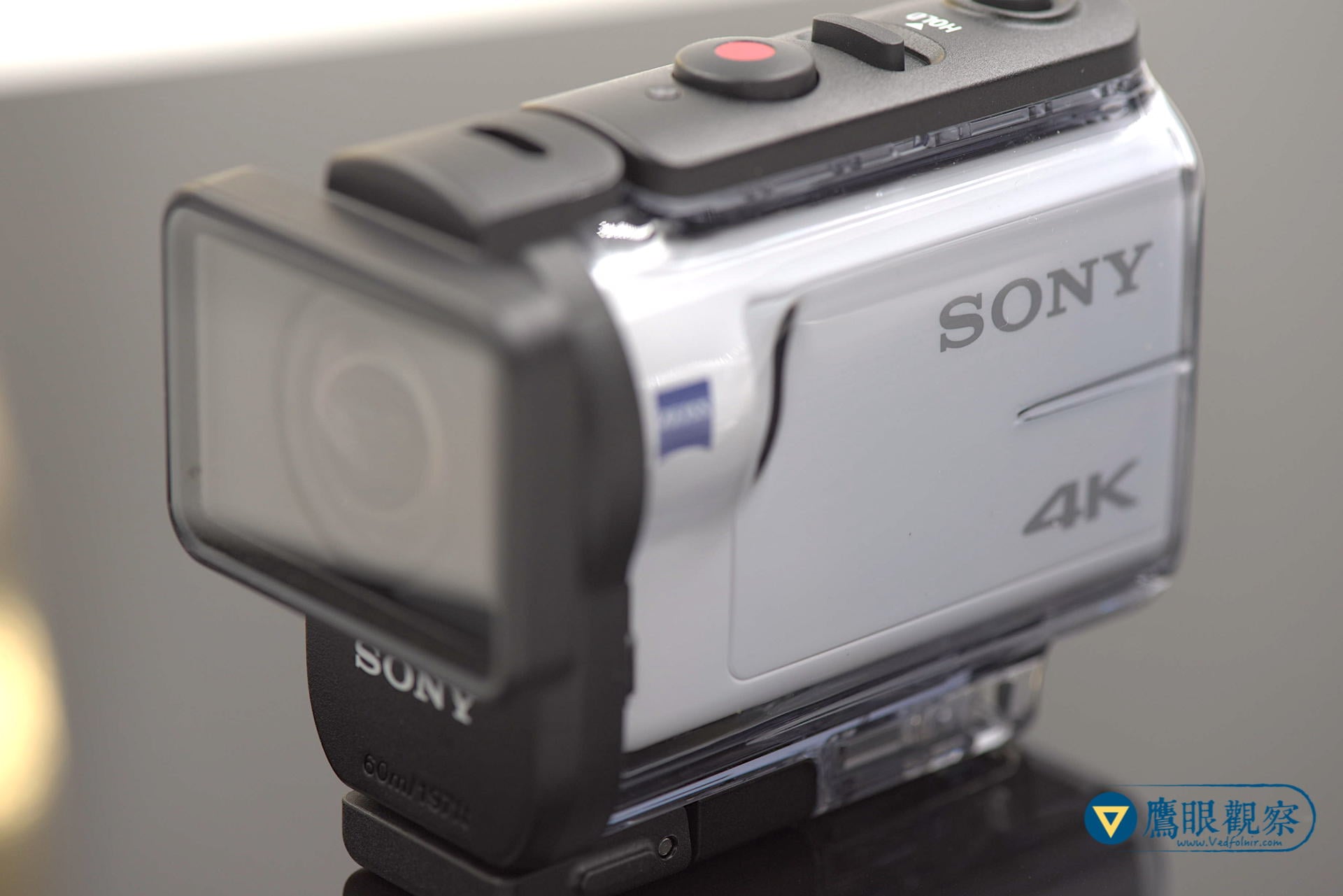 Sony FDR-X3000R action camera with waterproof housing.
As for marketing claims boasting huge digital zoom multiples, please skip them entirely—they are pure illusion. If you genuinely need telephoto reach, only compare the optical zoom capability.
Furthermore, it is crucial to verify whether the body provides expansion ports for external lighting and audio recording equipment. For instance, Sony often employs proprietary multi-interface shoes, which prevent generic third-party gear from being mounted directly; you must either purchase Sony’s dedicated accessories or rely on external mounting cages and brackets for adaptation.
In addition, I personally recommend Sony camcorders because of their superior low-light performance in dim environments, and some models even offer night-shot functionality. While you might not use night vision every day, having it available makes shooting quite entertaining.
Lastly, unless you are engaged in commercial production, a 1080p Full HD camcorder will easily serve you well for 5 to 10 years without becoming obsolete.
With 4K camcorders now stepping into the spotlight, I imagine they could easily hold their ground for another decade. Display resolution reaching 4K feels like it has reached an inflection point where jumping to 8K offers diminishing returns for human vision.
In the end, I purchased the unit detailed in “SONY HDR-XR500 Digital Camcorder Unboxing and Bo’ai Road Shopping Experience”. Readers interested in a hands-on review are welcome to check it out.
Support Independent Perspectives & In-Depth Insights
Every thoughtful analysis and candid critique comes from our dedication to truth and quality. We choose not to follow sensational algorithms or clickbait headlines.
Sustaining independent research requires reader support. Make a one-time or monthly contribution, securely processed by Google.
Payments secured by Google · Manage or cancel anytime in your Google Account




Comments