
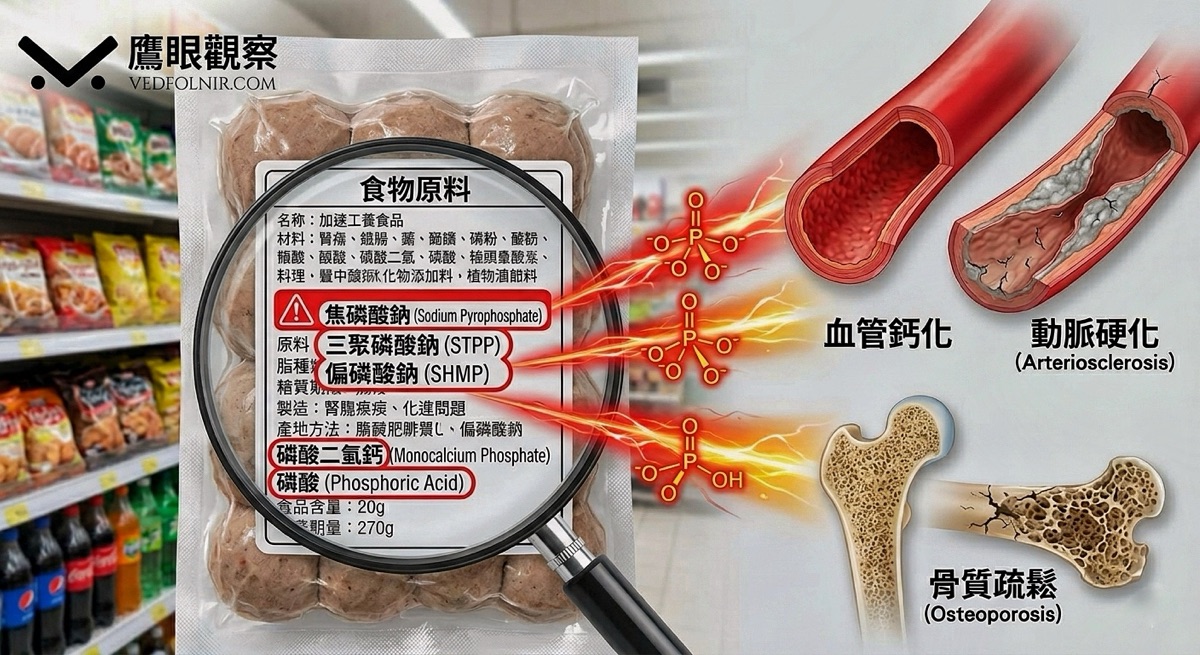
When we walk into a supermarket, more and more people habitually check calories and protein first. But for patients with cardiovascular disease, kidney disease, or gout, the real devil that determines health is often hidden in those chemical names you cannot pronounce.
The prevalence of chronic kidney disease on the island of Taiwan has remained high for years, and this is inseparable from our dietary habit of relying heavily on processed foods.
Phosphorus is an essential mineral for the human body, but with the push of the food industry, what we consume is no longer the “natural phosphorus” from protein, but “chemical phosphorus” with an absorption rate approaching 100%.
Why Is “Chemical Phosphorus” a Silent Killer?
Phosphorus in natural foods (such as meat and beans) is organic phosphorus, with a human absorption rate of about 40% to 60%, and the intestines have a natural filtering mechanism for it. However, the “phosphates” added to processed foods are inorganic phosphorus. Once these substances enter the intestines, they pour directly into the bloodstream like a flood.
Once blood phosphorus levels spike, the body, in order to maintain balance, forcibly extracts calcium from the bones to neutralize it. Over the long term, this is not just a problem of osteoporosis — the precipitates formed by calcium-phosphorus binding lodge on blood vessel walls, causing vascular calcification and hardening, which is precisely the fuse for cardiovascular disease and stroke. For readers with impaired metabolic capacity, this is undoubtedly a chronic poison that accelerates organ failure.
See Through the “Phosphorus” Trap on Labels
To protect yourself, you don’t need to become a chemist. Before buying any packaged food, simply flip to the “ingredient list” on the back.
Food regulations stipulate that ingredients must be listed from high to low by content. If the word “phosphate” appears earlier, it means you are taking in more chemical phosphorus. These additives are usually disguised as water-retention agents, leavening agents, or flavor enhancers, hidden in meatballs, ham, cakes, and even the coffee creamer you drink every day.
Battlefield One: Water Retention and Quality Improvers (Processed Meat, Ramen)
The great demon king of the processing world, responsible for locking in water and creating unnatural elasticity. Seeing these names is like watching a trailer for vascular hardening.
Food Additive Name | Purpose (Manufacturer’s Advantage) | Harm to the Body (The Truth) | Danger Level Sodium Metaphosphate | Increases water retention, prevents rancidity | 100% absorption; causes osteoporosis, vascular calcification | ★★★★★ Sodium Pyrophosphate | Stabilizes protein, springy texture | Interferes with calcium and magnesium absorption, increases kidney excretion pressure | ★★★★★ Sodium Polyphosphate | Chelates ions, prevents discoloration | Blood phosphorus spikes, induces severe skin itching | ★★★★★ Sodium Tripolyphosphate | Prevents meat from losing water and shrinking | Long-term accumulation causes soft tissue calcification | ★★★★★ Sodium Dihydrogen Phosphate | Adjusts pH | Directly raises blood phosphorus indicators, damages cardiovascular structure | ★★★★★
Battlefield Two: Leavening Agents (Cakes, Cookies, Pancakes)
To skip the time cost of natural fermentation, chemical leavening agents are a frequent guest at afternoon tea. The price of fluffy dough is often fragile bones.
Food Additive Name | Purpose (Manufacturer’s Advantage) | Harm to the Body (The Truth) | Danger Level Sodium Acid Pyrophosphate (SAPP) | Precisely controls fermentation volume | Double blow of high sodium and inorganic phosphorus, high vascular pressure | ★★★★☆ Calcium Dihydrogen Phosphate | Strengthens dough structure | Excess phosphorus forcibly takes away bone calcium, weakening bone quality | ★★★★☆ Sodium Aluminum Phosphate | Bright color, fluffy texture | Beyond phosphorus risk, aluminum residue may damage the nervous system | ★★★★★
Battlefield Three: Flavor Enhancers and Acidity Regulators (Cola, Instant Noodle Soup Packets)
Behind the refreshing sourness and umami is a pincer attack of uric acid and blood phosphorus. Liquid phosphoric acid in particular gives the body almost no chance to intercept it.
Food Additive Name | Purpose (Manufacturer’s Advantage) | Harm to the Body (The Truth) | Danger Level Phosphoric Acid | Provides cola’s refreshing sourness | Erodes tooth enamel; a main culprit of vascular hardening | ★★★★★ Disodium Guanylate | Enhances umami | Metabolism produces uric acid, easily triggers gout | ★★★☆☆ Disodium Inosinate | Increases umami depth | Gout landmine; increases moderate phosphorus burden on kidneys | ★★★☆☆
Battlefield Four: Emulsifiers and Anti-Caking Agents (Creamer, Cheese, Sauces)
The price of a perfect appearance is an invisible burden. The powder that prevents caking is quietly seeping into every bite of your daily diet.
Food Additive Name | Purpose (Manufacturer’s Advantage) | Harm to the Body (The Truth) | Danger Level Tricalcium Phosphate | Prevents milk/sugar powder from caking | Extremely fine particles, astonishing intestinal absorption rate | ★★★★☆ Lecithin | Makes oil and water blend smoothly | An organic phosphorus source, absorption rate about 50%, relatively safe | ★★☆☆☆ Phosphate Starch | Improves sauce viscosity | Hidden in various sauces, easy to over-consume | ★★★☆☆
Simple Toxin Summary:
- Identify the five-star demon kings: If the ingredient list shows phosphates starting with the characters “pyro,” “meta,” or “poly,” put it straight back on the shelf. They are 100% absorbed inorganic phosphorus.
- Beware the three-star assassins: Flavor enhancers (such as disodium guanylate) have low phosphorus content but are a fuse for gout patients.
- Pitfall-avoidance guide: The more incredibly springy the texture and the more vivid and non-fading the color of a processed product, the more chemical phosphorus is hidden inside.
To you who are caring for your family: The longer the chemical name, the farther from health.
Three Steps to a Low-Phosphorus Life
Once you see through the disguise of additives, you can thoroughly change your household’s dining habits through the following three steps:
- Give up the obsession with “springiness”: Those processed meats that don’t shrink after sitting at room temperature for a long time and have an unnaturally crisp texture (such as meatballs and crisp sausages) almost all contain high doses of sodium pyrophosphate or sodium metaphosphate. Return to whole foods — though the texture is softer, this is the taste your body recognizes.
- Quit dark carbonated drinks: Cola and some canned teas add pure phosphoric acid to adjust acidity and flavor. This liquid phosphoric acid is absorbed the fastest, with the most direct impact on the kidneys and blood vessels.
- Understand “hidden” umami: Gout patients must not only avoid purines but also beware of disodium guanylate in flavor enhancers. Although it makes soup taste fresher, it interferes with uric acid metabolism and triggers severe pain.
Conclusion: The Choice Lies Behind the Label
Health is not built by stacking expensive supplements, but by the “visual filtering” at every purchase.
When you learn to skip those complex chemical symbols and choose foods with the shortest ingredient list closest to their original form, you are already fighting for more healthy space for your blood vessels and kidneys.
Support Independent Perspectives & In-Depth Insights
Every thoughtful analysis and candid critique comes from our dedication to truth and quality. We choose not to follow sensational algorithms or clickbait headlines.
Sustaining independent research requires reader support. Make a one-time or monthly contribution, securely processed by Google.
Payments secured by Google · Manage or cancel anytime in your Google Account



Comments