
The rove beetle (Staphylinidae) is an insect featuring an eye-catching orange-and-black pattern. The toxicity of its hemolymph causes severe skin damage on warm summer nights, earning it the notorious moniker of a “crawling chemical bomb.”
As the weather heats up, this formidable little insect begins making people anxious again. While many people have heard of it, encountered it, or suffered from its venom, many others remain completely unaware of its existence—and I used to be one of them.
The severe dermatitis, burning pain, and ulceration triggered by rove beetles require us to better understand this small creature, enabling effective prevention and treatment strategies.
I only discovered the existence of rove beetles in recent years. In Tamsui, I had never encountered one. The first time I saw one in person was inside my graduate school laboratory. Don’t misunderstand—although I studied miscellaneous engineering, I wasn’t researching insect ecology.
At that time, my graduate school lab building was surrounded by wilderness. The lab was located on the fifth floor, and the windows had screens (though with noticeable holes). Even so, I spotted rove beetles on three separate occasions over two summers, indicating a dense local population.
What Kind of Insect Is a Rove Beetle?
Rove beetles (Staphylinidae) possess abbreviated elytra (wing covers) that leave most of their abdomen exposed; they only unfurl their flight wings when airborne, hence their name in Chinese meaning “hidden wings” (similarly, ladybugs keep their delicate wings hidden beneath hard hemispherical shells).
Rove beetles belong to the phylum Arthropoda. The family encompasses 14 subfamilies, over 900 genera, and more than 20,000 closely related species worldwide. Typically measuring about 0.5 to 1.0 cm in length, they resemble ants, making them easy to overlook at a glance.
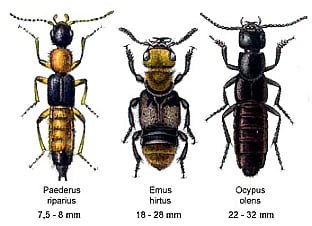 Staphylinidae (Fauna germanica. Bd. II, Stuttgart. 1909)
The most commonly encountered toxic species belong to the genus Paederus, such as the “rove beetle (Paederus littoralis)” shown on the left above, which features an orange-yellow thorax, orange-and-black abdominal banding, and a blue-black head and abdomen. Locally dubbed “blue-green ants,” their vibrant color contrast makes them easier to spot than uniformly dark species.
However, keep in mind that these insects measure only about one centimeter at most. For those of us who aren’t entomologists, accurately identifying specific species in the wild is challenging.
In my view, the easiest visual identifier is the beetle’s conspicuous orange-yellow segments (in other words, I have zero visual alertness toward purely dark rove beetles). Once you spot an insect with similar banded features, keeping your distance is best. Even though I enjoy hiking, I have no desire to provoke wild bugs.
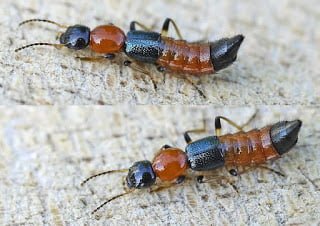 Paederus littoralis (Photographer: ©entomart)
As mentioned earlier, my lab building was surrounded by untamed wilderness, which hints at their ecological preferences. Farm fields, grasslands, and woodland edges are prime rove beetle habitats. Furthermore, because rove beetles exhibit positive phototaxis (attraction to artificial light), they stay out of sight during the day but frequently invade lit indoor spaces at night.
Their peak activity spans from April to October each year, coinciding with peak summer outdoor lifestyle. Consequently, news reports of rove beetle injuries routinely surface every year.
Common scenarios include leaving doors and windows wide open without air conditioning at night, accidentally crushing beetles while rolling over in bed, or riding a scooter without a full-face helmet visor lowered, where flying beetles hit the eye and almost cause corneal damage or blindness.
Of course, media sensationalism exists. Recently, a viral post circulated on Facebook warning people about rove beetles, accompanied by a shocking image of a young girl’s hand swollen to the size of several tennis balls. That certainly stoked intense panic.
However, when I searched through medical literature and documented clinical records, I found no cases of such extreme volumetric swelling. That viral photo was clearly a misattribution or hoax.
Preventing and Treating Rove Beetle Dermatitis
The most frequent medical complaint is Paederus dermatitis (rove beetle dermatitis).
Rove beetles do not actually bite or sting humans. However, when people feel a bug on their skin, their instinctive reaction is to swat or slap it—sometimes even swatting blindly before seeing what touched them. To a tiny insect, that impact is the equivalent of a human being hit head-on by an airplane.
If you miss, everyone walks away unscathed. But if you crush the beetle directly against your skin, its internal hemolymph containing “pederin” ruptures and splatters across your epidermis.
Pederin is an extraordinarily potent vesicant. Within just 10 seconds of contact, a severe burning sensation begins, rapidly culminating in erythematous blisters and ulceration. If you reflexively rub the affected area with your forearm or fingers, you will smear the pederin across other parts of your body, resulting in extensive linear chemical burns.
Therefore, remember: never wipe your face with your sleeves or rub your skin indiscriminately. If you accidentally transfer pederin to sensitive organs such as the eyes, mouth, or groin, the consequences can be excruciating.
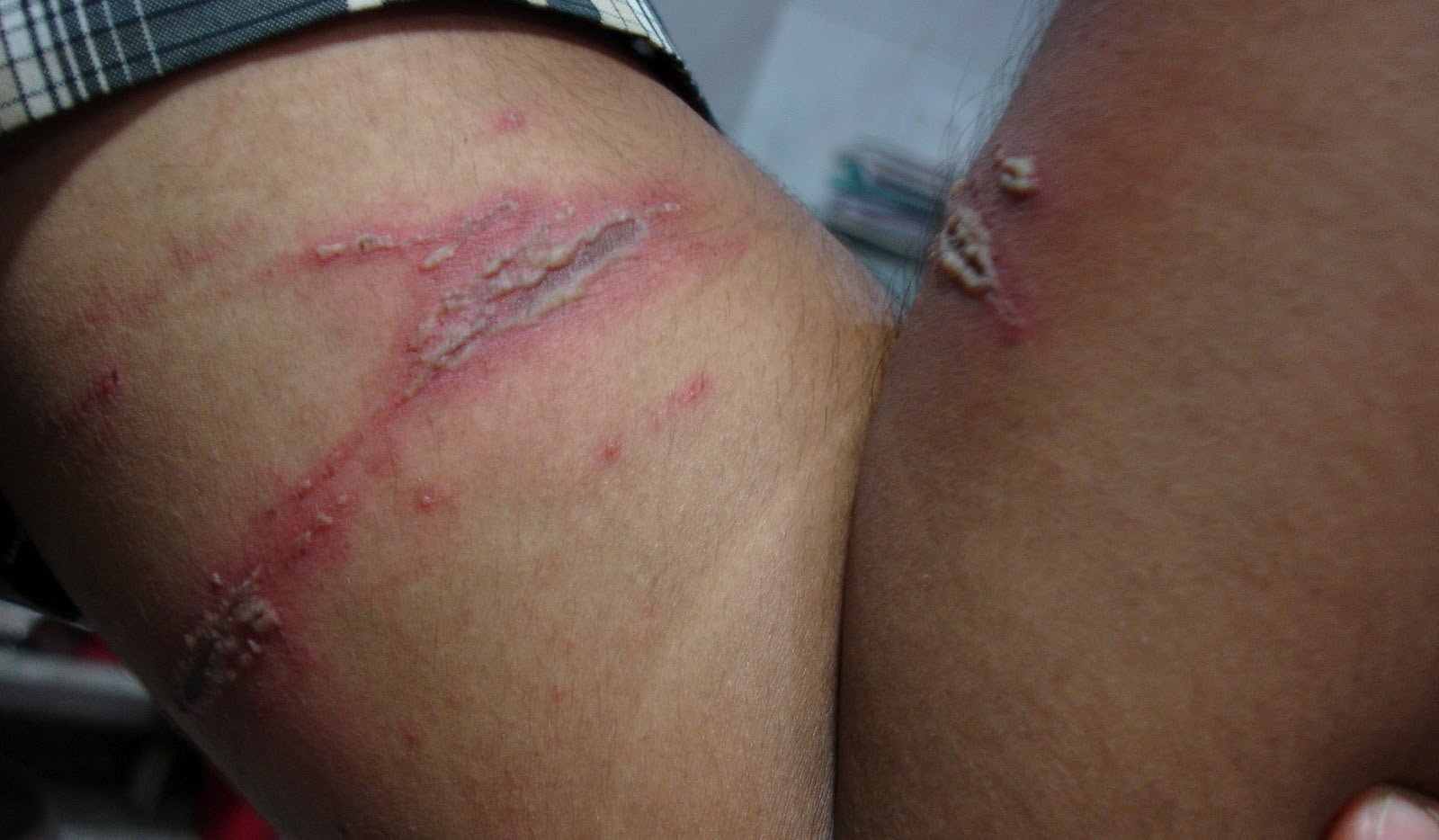 Clinical presentation of Paederus Dermatitis (showing characteristic “kissing lesions”)
In my mountaineering experience, if an insect lands on your body—unless it is a tick or a leech—the best approach is to shake it off vigorously like a dog exiting water, or gently blow it away with your breath. Once it is off your body, you can decide whether to set it free or dispose of it.
Furthermore, while crawling, rove beetles can exude minute amounts of pederin from their joint cavities. Folk folklore previously blamed this on “huntsman spider urine” causing mysterious skin blisters, but the true culprit was almost certainly a crawling rove beetle.
Skin traversed by a rove beetle often develops characteristic linear erythematous streaks (“whiplash dermatitis”), which may progress into pustules or blisters. When managed promptly (flushing immediately with abundant lukewarm water and soap, followed by medical evaluation), lesions generally resolve within about a week. Gentle skin care is essential to prevent secondary bacterial infections.
Although rove beetles can fly, their flight is clumsy and their crawling speed is slow. I once disposed of two inside the lab using tissue paper. Knowing full well that their fluids contain noxious vesicants, I wiped down every surface they crawled over multiple times with concentrated rubbing alcohol to neutralize any residual pederin.
If possible, avoid crushing them at all. Unless you have the means to safely isolate and cleanse toxic hemolymph, leaving them alone or escorting them out gently is far safer than causing an accidental chemical splatter.
Finally, as summer approaches, pay attention to your clothing when heading into rural or overgrown areas. Avoid wading into tall grass in shorts and short sleeves. At night, keep window screens intact, close balcony doors, and avoid sleeping right under bright uncovered lights so unexpected rove beetles don’t wander indoors uninvited.
Support Independent Perspectives & In-Depth Insights
Every thoughtful analysis and candid critique comes from our dedication to truth and quality. We choose not to follow sensational algorithms or clickbait headlines.
Sustaining independent research requires reader support. Make a one-time or monthly contribution, securely processed by Google.
Payments secured by Google · Manage or cancel anytime in your Google Account



Comments