
GitHub recently displayed a prominent dashboard banner: “On April 24 we’ll start using GitHub Copilot interaction data for AI model training unless you opt out. Review this update and manage your preferences in your GitHub account settings.” In plain terms, they are launching an aggressive data-harvesting program: unless you manually opt out, your private development data will become training fuel for next-generation AI models.
By bypassing active consent and imposing “opt-out by default” on individual users, this update oversteps the digital sovereignty of independent developers. Every line of business logic you type, and every prompt tweak you commit, is tracked and transmitted—effectively providing free, high-end fine-tuning data to commercial models operated by Microsoft and OpenAI.
To safeguard your proprietary code assets, navigate to your account Settings > Copilot page. Two essential toggles govern your data flow and legal exposure:
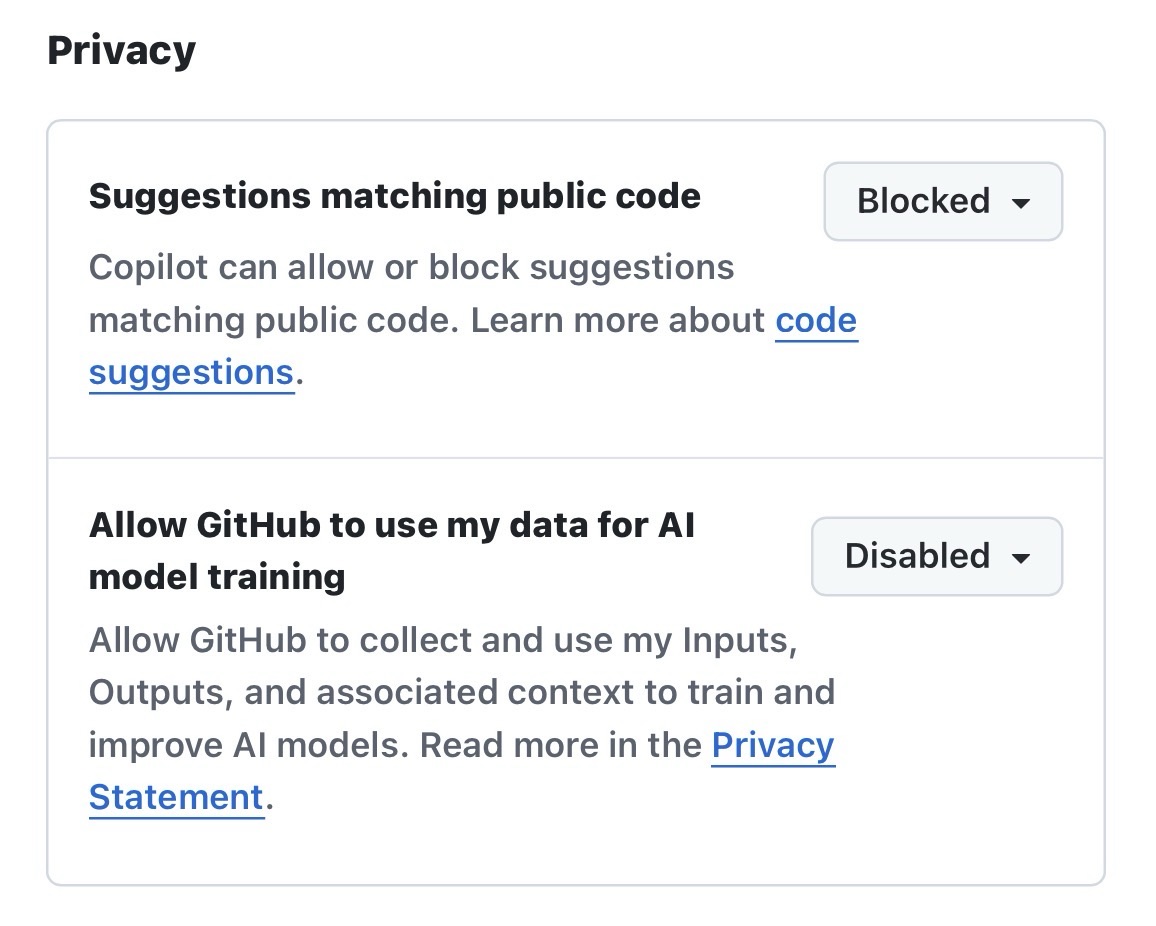
GitHub Settings: Privacy
First, turn off “Allow GitHub to use my data for AI model training”.
This is the primary operational boundary. Leaving this enabled grants GitHub permission to collect your Inputs (prompts, raw code context) and Outputs (AI completions and suggestions).
While Microsoft claims telemetry undergoes de-identification, neural models remain largely opaque black boxes. No vendor can guarantee that your proprietary algorithms or sensitive trade secrets won’t resurface as auto-complete recommendations in a competitor’s editor.
Second, configure “Suggestions matching public code” to Block.
This toggle acts as a critical legal firewall. It prevents Copilot from suggesting code snippets that closely duplicate public GitHub repositories (sequences over 150 characters).
If you inadvertently accept verbatim snippets covered by viral copyleft licenses like GPL, your entire proprietary repository could face legal liability or forced open-sourcing. Setting this policy to Block is fundamental hygiene for professional developers to guard against license contamination.
Taking proactive control of these toggles is not about rejecting AI tooling; it is about establishing firm boundaries between creators and tech giants. When corporations attempt to harvest developers’ intellectual labor via deceptive default settings, manually saying “No” is the simplest safeguard of our independence. Take five minutes before April 24 to verify your privacy configurations.
Support Independent Perspectives & In-Depth Insights
Every thoughtful analysis and candid critique comes from our dedication to truth and quality. We choose not to follow sensational algorithms or clickbait headlines.
Sustaining independent research requires reader support. Make a one-time or monthly contribution, securely processed by Google.
Payments secured by Google · Manage or cancel anytime in your Google Account




Comments