

If we were to conduct a survey titled “Top X Things That Trouble Independent Travelers”, what travel concerns would you list?
Local language barriers are certainly a major anxiety for many. Safety concerns—worrying about theft, muggings, or pickpockets—trouble quite a few travelers as well. Packing dilemmas like what clothes to wear, which gear to bring, and how to travel ultralight are equally headache-inducing.
As for me, one of the biggest items would definitely be booking flights—specifically, hunting down super discounted, ultra-cheap plane tickets. The booking process itself feels like an obsession (is this a chronic trait among information junkies?).
In recent years, thanks to the rise of Low-Cost Carriers (LCCs, budget airlines), independent travelers willing to trade travel time and onboard luxury for savings have gained a massive advantage. Established full-service airlines haven’t ignored this trend either; for instance, Tigerair Taiwan, backed by China Airlines, entered this competitive aerial market.
Similarly, Peach Aviation, which enjoys immense popularity on routes to Japan, is a budget carrier backed by Japan’s renowned carrier All Nippon Airways (ANA).
Beyond their already low baseline fares, the greatest advantage of low-cost carriers is their frequent waves of promotional discounts, deployed strategically to maximize seat utilization and fill empty seats.
Take Peach Aviation: regular economy fares [1] on their Taipei–Okinawa route typically range between NT$2,560 and NT$3,230 (reaching up to NT$7,010 on peak dates). Yet they regularly launch promotional campaigns where fares drop to NT$1,900 on select dates.
Peach also occasionally rolls out even more astonishing flash sales, slashing tickets down to NT$980—though snagging these requires exceptional luck and timing.
Having covered this background on budget airlines, it’s clear that ticket pricing is dynamic and influenced by numerous variables.
Now let’s dive into the core question: “How to Buy the Cheapest Airline Tickets?”
Take a look at Figure 1 below, which displays December return flight prices when booking a round-trip ticket between Taipei and Okinawa. Alongside the regular economy fares shown in black, you can see ultra-discounted promotional fares in magenta at NT$1,900.
For most travelers, NT$1,900 already represents a stellar deal, so they promptly pull out their credit cards, make the payment, and eagerly await departure day.
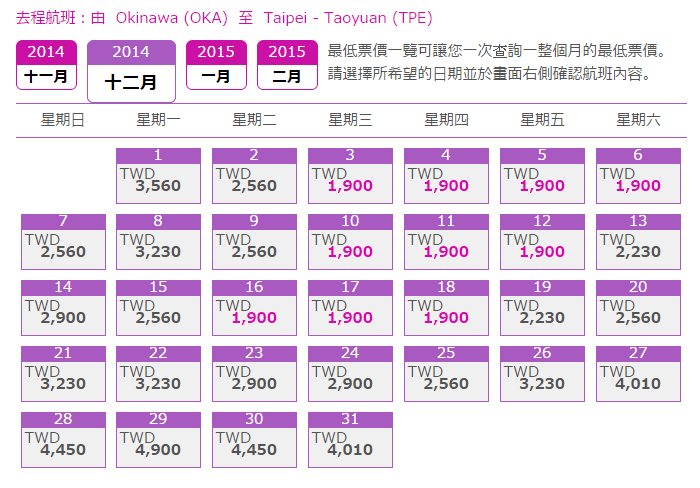 Figure 1: Return flight price list for a Taipei–Okinawa round-trip ticket
However, take a look at Figure 2 below. This is also the December fare calendar for Okinawa to Taipei. The color scheme matches Figure 1, with regular fares in black and discounted fares in magenta. But do you notice that the ticket prices are visibly different?
In Figure 1, the magenta discounted fare is 1,900, while in Figure 2, it is 4,780. The catch is that these two prices use different currencies: Figure 1 is quoted in New Taiwan Dollars (TWD), whereas Figure 2 is quoted in Japanese Yen (JPY).
According to the Bank of Taiwan’s posted cash sell rate at the time (2014.10.27), 1 JPY was roughly 0.2838 TWD. That means 4,780 JPY converts to approximately NT$1,357.
For the exact same date, the exact same flight, and the exact same ticket, the price difference was NT$543!
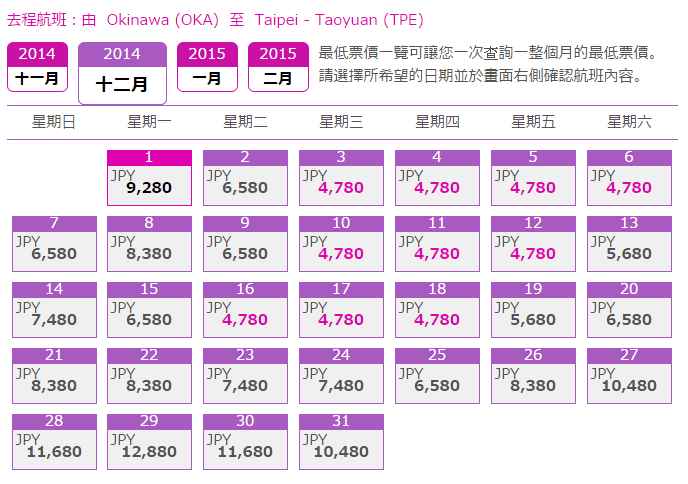 Figure 2: One-way ticket price list from Okinawa to Taipei
The fare in Figure 2 is for booking a standalone one-way flight from Okinawa to Taipei, which defaults to Japanese Yen pricing. Conversely, Figure 1 reflects booking a round-trip ticket departing from Taipei, where the entire itinerary is priced in New Taiwan Dollars.
This disparity arising from different booking approaches is the core revelation of this article—and an insider trick shared among seasoned independent travelers. By planning your itinerary thoughtfully, booking separate one-way legs isn’t necessarily more expensive; in fact, it can be significantly cheaper!
Next time you book flights, beyond searching for standard round trips, try pricing each leg separately to see if booking two one-way tickets saves you money [3].
In the past, traditional travel agencies insisted that buying round trips bundled together yielded the best prices. But for modern budget airlines, the primary driver of profitability is maximizing seat occupancy.
The rise of budget airlines signals that carriers can now sell directly to consumers, cutting out travel agents and intermediary middlemen (middleman models will inevitably decline across industries, from automotive sales to real estate). With ongoing technological progress, real-time price transparency, and diversifying travel habits, being wedded to bundled round-trip tickets is no longer necessary.
Further Reading:
- Peach Aviation offers two fare tiers: the no-frills ultra-budget “Happy Peach (HP)” and the enhanced “Happy Peach Plus (HPP)”, which includes amenities closer to standard economy class. Key differences beyond price (typically a NT$1,000 to NT$3,000 spread) include booking deadlines (HP must be booked before the departure date, while HPP can be purchased up to one hour before flight time), flight changes (HP charges change fees; HPP offers free changes), refunds (HP is non-refundable; HPP refunds into Peach points), checked baggage (HP requires an extra fee of around NT$750, while HPP includes one piece free [2]), and seat selection (HP charges for selection; HPP includes most standard seats free).
- Budget Airlines: Complete Guide to Carry-On Baggage Size, Dimensions, and Weight Limits (9 Low-Cost Carriers).
- Quick Tip: Many transportation services and tourist attraction tickets offer distinct pricing for local residents versus foreign tourists, and some even impose restrictions prohibiting purchases by non-residents or vice versa. Always double-check pricing policies while deal-hunting. For instance, at the National Palace Museum, domestic visitors from Taiwan enjoy cheaper admission than foreign tourists—make sure not to pay the higher foreign tourist rate by mistake at the ticket counter.
- Booking Japanese Minshuku & Hotels Early: Exclusive Accommodation Deals.
Support Independent Perspectives & In-Depth Insights
Every thoughtful analysis and candid critique comes from our dedication to truth and quality. We choose not to follow sensational algorithms or clickbait headlines.
Sustaining independent research requires reader support. Make a one-time or monthly contribution, securely processed by Google.
Payments secured by Google · Manage or cancel anytime in your Google Account




Comments