

A new scam tactic has surfaced on Facebook—please take caution. Today, I received a Facebook message from an unfamiliar contact claiming that my account had been reported for violating Facebook’s user policies, instructing me to click an attached link within one hour or risk having my account suspended.
The sender was certainly not official Facebook staff, nor did the account look like a typical bot profile. Most likely, they were an earlier victim who had fallen for a phishing link, turning their compromised account into a springboard for black-hat scammers.
Examining the URL provided by the attacker reveals that the browser would be redirected to a phishing application built using Facebook Apps. This is where black-hat hackers show their cunning: leveraging Facebook’s developer platform to craft apps tailored for credential theft.
Below is the original text and screenshot of the fraudulent message for your reference:
Original Scam Message
Facebook Security Warning! Your account has been reported to have violated policies considered offensive or insulting by Facebook users. Perhaps the content you wrote is vulgar, profane. Or uploaded images that rudely insult or damage others. You must confirm your account to stop warning and deactivating your account.
Please confirm your account at the address below:
└► https : // apps.facebook.com / protection-fbme / ?update_system
Your time is limited, within 1 hour after we deliver this notice!
Thank you for your help to improve our services
Facebook Team Terms of Service. Privacy Policy Copyright © 2014™ All Rights Reserved.
From the screenshot of the conversation below, you can see that our team member even replied with a promotional link—and the scammer actually saw it!
Lately, whenever we receive spam or scam messages across Facebook, LINE, or WeChat, we treat it as commercial break time and reply with our website link for counter-marketing.
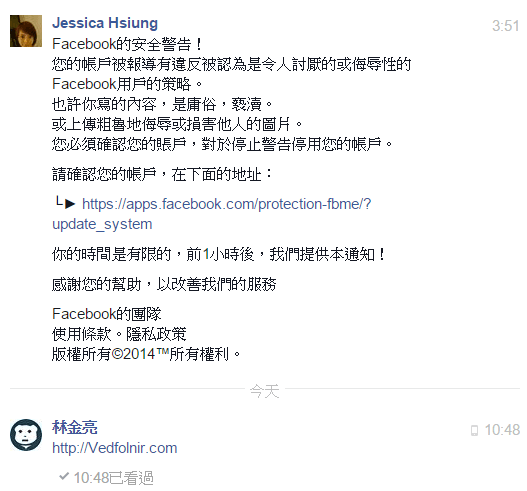 Facebook Security Warning Scam Conversation Record
Seeing this screenshot reminded me of an earlier article I wrote: [Urgent Notice] New Facebook Scam Technique: Using Fake Contests to Steal SMS Verification Codes, where I shared screenshots of another scam method. Afterward, an anonymous user from a Hsinchu Science Park domain insisted my article was plagiarized. But once I responded earnestly with evidence, they vanished without another word. Netizens these days love making baseless accusations and fleeing. Who knows why he believed scammers were only allowed to send that script to him and nobody else.
Sending such a message at 3:00 AM demanding task completion within one hour is clearly calculated to catch people off-guard while half-asleep, prompting them to click without thinking.
Another reason, I suspect, is to shorten the window before being reported.
Unfortunately for them, I didn’t get around to checking Facebook until nearly 11:00 AM. After glancing at it, I ignored it, intending to report them on my desktop computer once I got home. When I returned home that evening, I even booted up a dedicated quarantined testing machine to open the link safely—only to find that Facebook had already taken the rogue app down.
I had actually hoped to let them scam me once just to entertain them, and so I could write a more detailed investigative report.
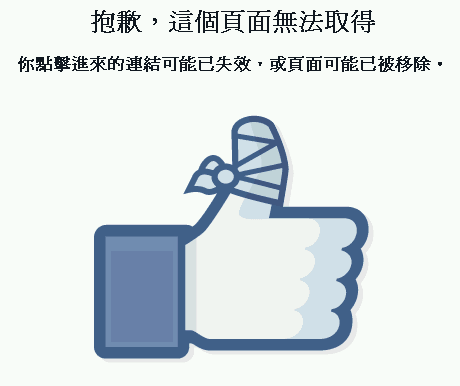 Link Expired
Although such phishing apps appear endlessly and are often riddled with grammatical errors and technical flaws, given that people still fall for them, running these operations must offer quite a lucrative success rate (ironically speaking).
To prevent scammers from exploiting similar deceptive apps, everyone should remain vigilant when receiving unsolicited messages. Unless you are truly locked out of Facebook and unable to log in, most of these alerts are merely online scams.
Honestly, the wording in this fraudulent message was shockingly imprecise—a real eyesore for any language perfectionist. If scammers can’t even bother to polish their phrasing, how do they expect to fool anyone? It was likely scripted via Google Translate by an overseas syndicate targeting non-native Chinese speakers.
References
- Things to Note When Receiving an icash Prize Notification SMS.
- Facebook Ad for McDonald’s Taiwan: A Chinese Scam or Official Promotion?
- Fresh Batch of Deceptively Thoughtful Scam SMS Messages: Raising Public Cybersecurity Awareness
- Tech Fraud: Exploring “1+1>2” Smartphone and Internet Scam Tactics
- Website and Email Extortion: You Have Been Hacked—Pay Ransom in Bitcoin to Protect Your Privacy!
Support Independent Perspectives & In-Depth Insights
Every thoughtful analysis and candid critique comes from our dedication to truth and quality. We choose not to follow sensational algorithms or clickbait headlines.
Sustaining independent research requires reader support. Make a one-time or monthly contribution, securely processed by Google.
Payments secured by Google · Manage or cancel anytime in your Google Account



Comments