
Today I want to discuss a banking phenomenon that has long existed. I have reflected on it several times before, though in daily life we rarely pay it much conscious attention. Having thought of it again, I decided to take this opportunity to write down my perspective. As for whether my views are right or wrong, I leave that to the reader’s judgment—these are simply my personal reflections.
Within Taiwan’s banking system, in order to maximize profits, one commercial strategy has effectively required customers to maintain strict loyalty to a single financial institution.
Regulators accommodated banks by establishing the Financial Information Service Co., Ltd. (FISC). One of FISC’s primary functions has been to collect clearing fees passively while operating the shared interbank settlement network across the entire nation.
Originally, when customers withdrew funds from Bank A’s ATM using a Bank A card, the transaction was strictly internal to that bank. Without needing FISC’s intervention, users directly drew their funds using banknotes owned by Bank A.
Conversely, if a customer wishes to withdraw funds from a Bank B account at a Bank A ATM, Bank A’s machine must route the request through FISC to communicate with Bank B. Coordinated among these three parties, Bank A’s ATM dispenses cash to Bank B’s customer. Later, Bank A reconciles the account and settles with Bank B through FISC. This is the standard mechanism behind interbank withdrawals.
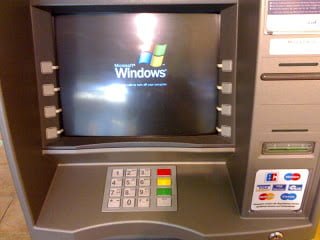
Prior to 2004, each interbank withdrawal incurred an out-of-pocket fee of NT$7 for the user, while interbank transfers cost NT$18. After 2004, the Financial Supervisory Commission (FSC) mandated that FISC lower the interbank withdrawal fee to NT$6 and the transfer fee to NT$17.
Later, in February 2012, the FSC once again instructed FISC to lower these transaction fees.
Consequently, in June of that year, FISC reduced the interbank withdrawal fee to NT$5 and interbank transfer fee from NT$17 to NT$15.
Whenever these fee reduction orders were handed down, prominent figures in banking and finance invariably pushed back publicly, arguing that domestic interbank transfer and withdrawal fees were already the cheapest compared to neighboring regions.
It is true that domestic interbank fees are remarkably low.
Banking executives pointed out that ATM fees in mainland China and Hong Kong often start from hundreds of dollars.
In my view, charging a fee for interbank withdrawals or transfers is entirely reasonable.
The real problem is that domestic banks lack the motivation to provide customers with truly superior service—whether constrained by statutory regulations, entrenched habits, or simply an unwillingness to incur extra operating costs.
Yet the banking industry fails to grasp the underlying essence of the matter: financial services should exist to allow people to fully enjoy the convenience of managing and using their money.
Instead, the banking sector has turned spending and accessing money into a tedious, cumbersome chore.
Whenever ordinary citizens need to withdraw cash or transfer funds, they end up wasting substantial time hunting for the cheapest workaround. For example, some people walk nearly half an hour away from their workplace just to find their specific bank’s ATM to save a nominal fee.
As everyone knows, a desert is formed grain by grain; the cumulative time lost to this banking friction is staggering.
Consider an overseas example: in supermarkets and even corner grocery stores across New Zealand, “Cash Out” services at the checkout register are standard.
Furthermore, banks there frequently offer specific account tiers that include five to ten free interbank ATM withdrawals every month.
By specific accounts, I refer to customizable sub-accounts that users can configure within their primary bank account. This not only facilitates financial management, but also provides varied perks and parameters—similar to a hybrid between checking and savings accounts, but far more flexible and rewarding.
The Cash Out service mentioned above allows cardholders to withdraw cash at most merchant checkout counters without paying any fees. In other words, beyond dedicated ATM kiosks, virtually every retail shop across the nation acts as a cash withdrawal outpost for all banks indiscriminately.
In that country, interbank ATM fees are around NT$45 to NT$60 equivalent.
Yet such high fees cause little inconvenience to the public, precisely because alternatives like Cash Out and monthly fee exemptions are readily available.
When people find that accessing their money is frictionless, aren’t they far more willing to circulate funds throughout the broader economy? Or perhaps do so almost instinctively (smile).
Therefore, the fee amount itself is missing the point entirely. The real crux is that domestic banks are reluctant to actively innovate services or pursue extensive commercial collaborations, remaining complacent and bound by inertia. Under such conservative management strategies, both national economic vitality and long-term banking profits remain constrained—all subsidized by the precious time citizens waste on every single cash withdrawal.
Support Independent Perspectives & In-Depth Insights
Every thoughtful analysis and candid critique comes from our dedication to truth and quality. We choose not to follow sensational algorithms or clickbait headlines.
Sustaining independent research requires reader support. Make a one-time or monthly contribution, securely processed by Google.
Payments secured by Google · Manage or cancel anytime in your Google Account



Comments