
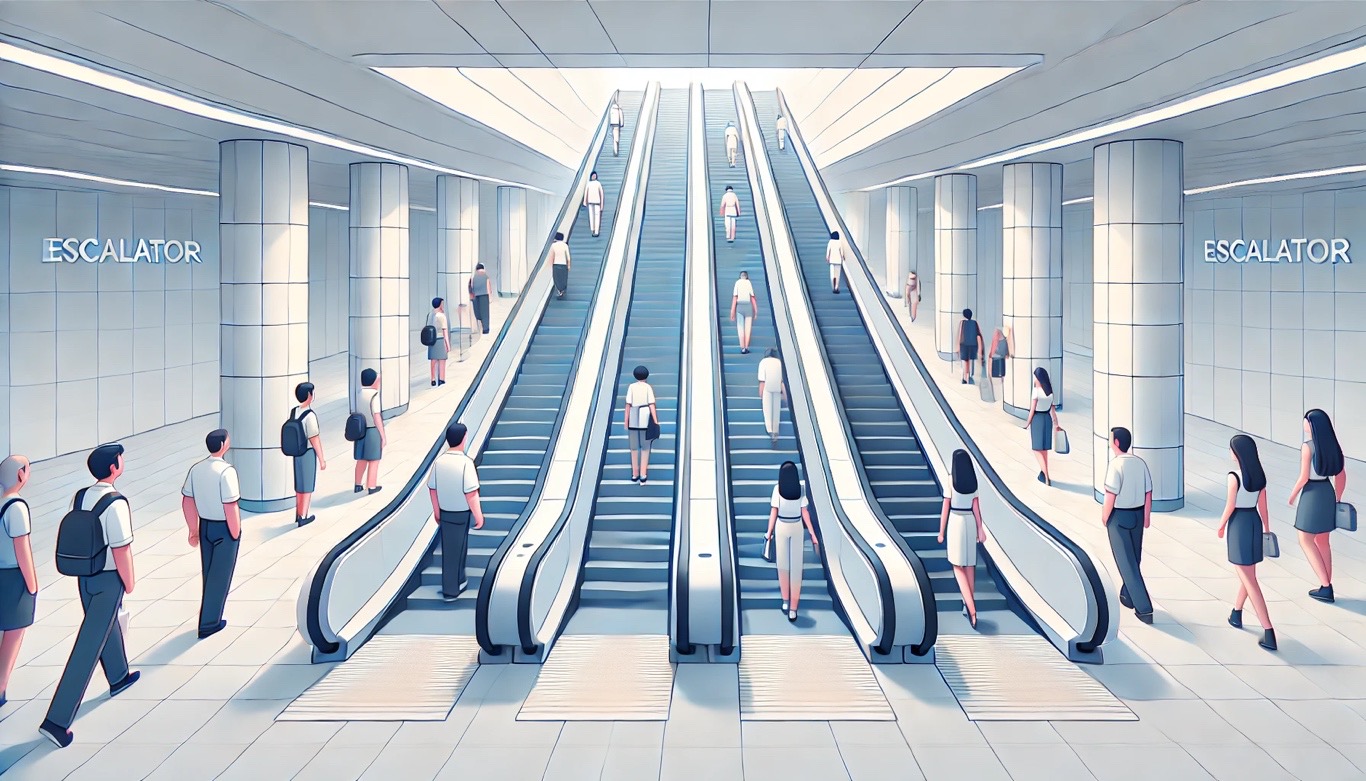
Across metropolitan transit and rail networks, public debate inevitably resurfaces over a classic urban question: Should escalator passengers stand on the right and keep the left clear for walking, or should both sides stand still?
In Taipei, although metro authorities modified announcements years ago to “hold handrails firmly and stand on steps,” eliminating mandatory right-side standing, deeply ingrained social etiquette still causes passengers to queue obediently on the right. In London, this etiquette is even more entrenched; tourists inadvertently blocking the left side of the escalator face immediate, sharp tutting from hurrying commuters.
In recent years, advocates of abolishing walking lanes and enforcing dual-side standing have turned to a singular holy grail: the Transport for London (TfL) field experiment conducted at Holborn Tube Station in 2015–2016.
Yet when we examine the raw empirical data of that famous trial, a startling realization emerges: the study’s findings have been profoundly decontextualized and distorted through selective internet commentary!
The Holborn Experiment: The Hidden Precondition Behind the 27% Throughput Spike
Let us reconstruct TfL’s famous three-week field trial in November 2015 at Holborn Station:
On two of the station’s three massive upward escalators, staff enforced “standing on both sides only, walking strictly prohibited,” while keeping the third escalator on traditional “walk on the left, stand on the right” rules. The resulting data stunned transportation circles:
- Traditional Single-Side Walking Escalator: Peak-hour throughput reached roughly 12,745 passengers per hour.
- Dual-Side Standing Escalator: Peak-hour throughput climbed to 16,220 passengers per hour.
- Headline Result: Hourly capacity surged by 27.3%, reducing the queue length waiting at the concourse entrance by nearly one-third.
Advocates quickly concluded: “Prohibiting walking increases throughput by nearly thirty percent—dual-side standing is indisputable scientific truth!”
However, the devil hides in the footnotes. The study featured a decisive physical precondition consistently omitted by advocates:
The test escalators at Holborn Station possess a vertical rise of 24 meters (equivalent to roughly 8 stories high, with over 300 individual steps). At such daunting heights, fewer than 40% of commuters were physically willing or able to hike up the entire flight, leaving over 60% choosing to stand still.
Dynamics of Crowd Movement: Long Escalators vs. Short Escalators
Understanding this 24-meter physical constraint reveals the fatal flaw in universal extrapolation:
| Metric | Holborn Super-Long Escalator (24m Vertical Rise) | Standard Metro Escalator (4–6m Vertical Rise) |
|---|---|---|
| Willingness to Walk | Extremely Low (~30%–40% willing to climb) | Extremely High (70%–80% briskly walk) |
| Left-Lane Utilization | Massive Idle Void (too exhausting to climb) | Densely utilized by rapid pedestrian flows |
| System Bottleneck | Dangerous concourse queues spilling backward | Rapid discharge of walkers off platforms |
| Dual-Side Standing Effect | Clears queues by utilizing unused space | Eliminates fast lanes, slowing everyone to 0.5 m/s |
In deeply buried subterranean stations like Holborn, where the public cannot hike eight stories, the traditional left-walking lane sits mostly empty. Forcing dual-side standing merely recaptures unused left-side space, boosting total throughput.
In standard metro stations, however, the vertical rise is merely one story (4 to 6 meters), taking pedestrians only 10 to 15 seconds to scale. Walkers move at 1.2 to 1.5 m/s (walking speed combined with escalator velocity).
Imposing standing-only mandates on standard short escalators strips rapid travelers of egress speed, forcing everyone to crawl at the mechanical baseline of 0.5 m/s and extending overall passenger transit times!
The True Driver of Evacuation: Entrance Queues, Not Step Density
From traffic engineering and queueing theory perspectives:
Transit evacuation efficiency is not determined by maximum instantaneous passenger packing on steps, but by the bottleneck queue accumulating before the escalator threshold!
When crowd arrival rates overwhelm entry thresholds, concourses choke with dangerous congestion. The optimal passenger protocol cannot be a rigid dogma; it must dynamically adapt to instantaneous crowd density:
- Extreme Peak Congestion (Crowds Spilling onto Platforms):
The overriding safety imperative is eliminating dangerous entrance bottlenecks. Under red alert, dual-side standing should be triggered to maximize cross-sectional discharge and evacuate platform choke points. - Off-Peak or Moderate Traffic:
When queues clear fluidly upon arrival, maintain walk-on-left, stand-on-right. Preserving an express lane for commuters making tight train transfers optimizes overall social utility.
The Myth of Mechanical Wear: Is 95% Uneven Wear Justification?
Critics frequently cite mechanical wear data, noting that transit systems (such as Nanjing Metro) report 95% of escalator chains exhibit asymmetrical wear on the right side.
In elevator engineering, this argument merely transfers routine maintenance costs onto commuter convenience:
- Periodic Direction Reversals Are Industry Standard: Modern public-transit escalators feature reversible drive motors. Routine maintenance protocols periodically alternate upward and downward directions every few months, naturally balancing lateral wear.
- Off-Center Loading Tolerances: Under international safety standards (EN 115 and ASME A17.1), escalator structural trusses are engineered with heavy fatigue margins. Single-side passenger loading falls completely within rated operational tolerances.
The Ideal Solution: Dynamic Intelligent Crowd Flow Systems
Rather than staging recurring moral debates, modern transit authorities should deploy intelligent crowd guidance:
- Optical Sensors & Threshold Triggers: Install 3D depth sensors or AI vision algorithms at escalator entrances to compute real-time queue lengths.
- Dynamic Adaptive Signaling:
- Overcrowded (Red Alert): Overhead displays and illuminated handrail LEDs switch to: “Peak Congestion: Please Stand on Both Sides; Do Not Walk.”
- Normal Flow (Green): Signage displays: “Hold Handrails Firmly (Left Lane Permitted for Walking).”
Empirical science seeks holistic system understanding rather than selective data points. Replacing blanket prohibitions with adaptive dynamic management represents the true hallmark of civil transportation maturity.
Support Independent Perspectives & In-Depth Insights
Every thoughtful analysis and candid critique comes from our dedication to truth and quality. We choose not to follow sensational algorithms or clickbait headlines.
Sustaining independent research requires reader support. Make a one-time or monthly contribution, securely processed by Google.
Payments secured by Google · Manage or cancel anytime in your Google Account



Comments