
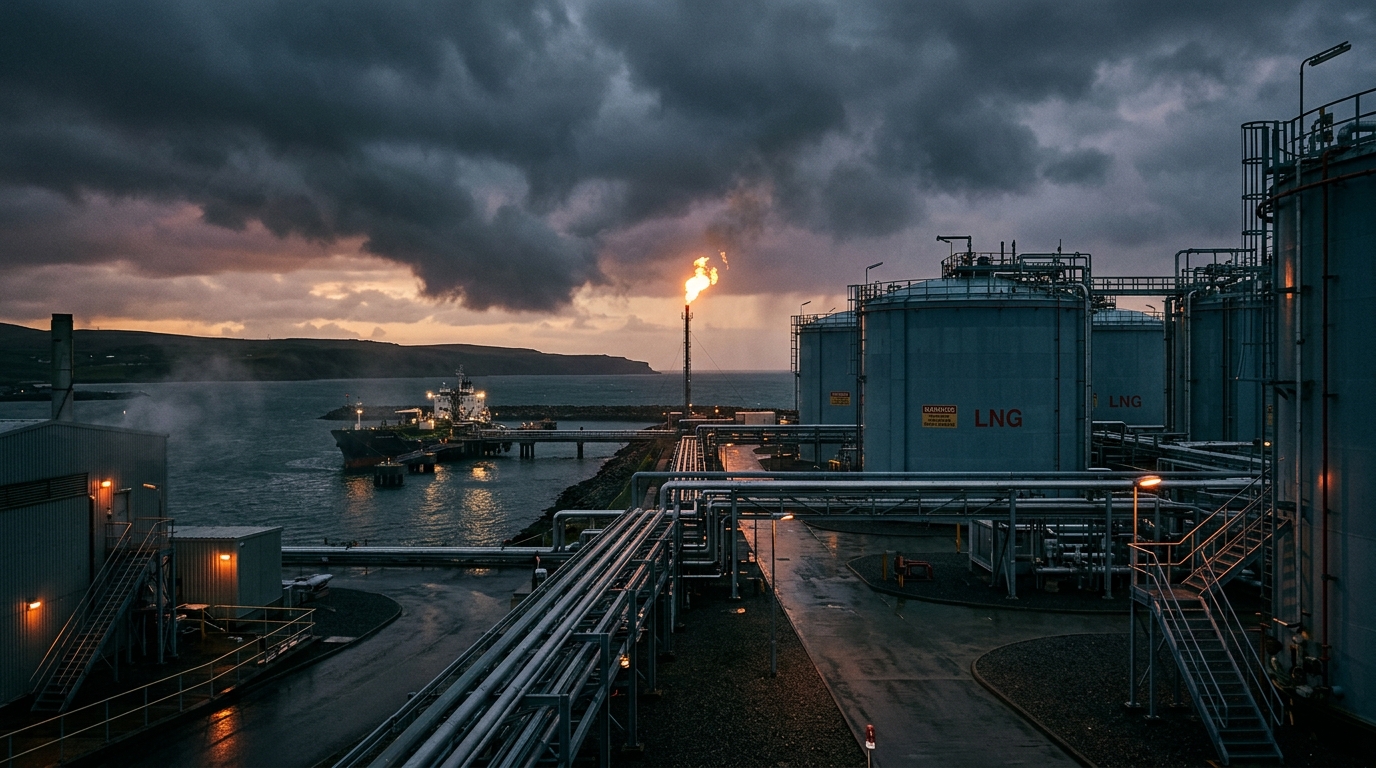
Since taking power, the Democratic Progressive Party (DPP) administration has treated its “Nuclear-Free Homeland” dogma as an inviolable ideological totem. To plug the massive baseload deficit created by the premature decommissioning of reliable nuclear plants, authorities aggressively rammed through a radical pivot toward “replacing coal and nuclear with natural gas.” Under this mandate, liquefied natural gas (LNG) was slated to generate over 50% of the island’s entire power supply, prompting a frenzy of receiving terminal expansions and massive cryogenic storage tank construction across Taiwan’s major commercial harbors.
Yet, when civil society and environmental coalitions raised grave alarms regarding the safety of ultra-low-temperature LNG storage tanks clustered adjacent to densely populated metropolitan corridors, Taipower Vice President Cheng Ching-hung brushed off legislative inquiries with a casual assertion: “An LNG storage tank explosion has never occurred anywhere in world history.”
Such bureaucratic spin may sound reassuring on the surface, but it is an insidious exercise in semantic sophistry. By deliberately narrowing public dread of “catastrophic gas infrastructure explosions” to the pedantic definition of “the physical rupture of a tank’s steel inner shell,” officials seek to whitewash the lethal perils endemic to the entire LNG supply chain.
1. Shattering the LNG Safety Myth: A Blood-Stained Global History
Taipower’s declaration that “storage tanks don’t explode” insults public memory and elementary physical science. Claiming that “pipeline leaks cause vapor cloud explosions, not internal tank detonation” is willful blindness.
Throughout global industrial history, catastrophic LNG accidents have repeatedly inflicted severe loss of life and devastating property destruction:
| Year & Location | Cause & Chain Reaction | Casualties & Structural Damage |
|---|---|---|
| 1944 Cleveland Disaster, Ohio, USA | Cryogenic embrittlement caused an LNG tank to rupture; boiling liquid flashed into vapor, infiltrated storm sewers, and triggered catastrophic chain explosions. | 128 fatalities, 225 critical injuries; several city blocks incinerated, dozens of homes and plants leveled. |
| 1973 Staten Island Disaster, New York, USA | Residual gas ignited during internal maintenance of an out-of-service LNG tank, triggering a violent deflagration that collapsed the concrete ceiling. | 37 engineers and workers killed instantly. |
| 2004 Skikda Complex Explosion, Algeria | Vapor leakage from an LNG liquefaction plant entered boiler rooms, causing an explosion equivalent to dozens of tons of TNT that destroyed three production trains. | 27 fatalities, 74 injuries; shockwaves rattled buildings kilometers away. |
| 2022 Freeport LNG Explosion, Texas, USA | Overpressurization ruptured an LNG transfer pipe, releasing a massive vapor cloud that detonated in a violent Vapor Cloud Explosion (VCE). | Paralyzed America’s second-largest LNG export terminal for over six months, roiling global gas markets. |
These painful milestones demonstrate an undeniable reality: the menace of LNG does not stem from whether a storage vessel detonates like an artillery shell. Rather, it originates from the physics of -162°C cryogenic liquid. Any valve malfunction, seismic pipe displacement, boil-off gas (BOG) pressure surge, or external shock causes cryogenic methane to instantly expand 600-fold in volume, forming dense, ground-hugging flammable vapor clouds. A single stray spark detonates catastrophic Vapor Cloud Explosions (VCE) and Boiling Liquid Expanding Vapor Explosions (BLEVE).
Waving away these risks with a slick talking point is not professional expertise—it is cynical bureaucratic self-delusion.
2. Four Fatal Vulnerabilities in the 50% Gas Blueprint
Betting half of the nation’s electricity on imported natural gas represents a reckless gamble that places national survival on a knife’s edge:
1. Astronomical Costs and Bleeding Balance Sheets
Natural gas is a volatile commodity subject to extreme geopolitical swings. Unlike the stable, low fuel costs of nuclear power, imported LNG is exorbitant. Following the Russia-Ukraine conflict, spot LNG prices skyrocketed. Reluctant to pass market prices onto voters, the administration forced state-owned Taipower to absorb crushing losses, with accumulated deficits exceeding hundreds of billions of NT dollars. Bailing out the utility with taxpayer subsidies is not a green transition—it is the systematic looting of public coffers to salvage flawed partisan policy.
2. A Fragile Maritime Lifeline: Seven Days of Safety Reserves
As an isolated island grid, Taiwan faces an existential vulnerability:
- Nuclear Power: Ultra-compact fuel rods run uninterrupted for 18 months per refueling cycle, with two to three years of fuel reserves stored securely on-site, entirely immune to blockades.
- Liquefied Natural Gas (LNG): Because cryogenic storage is extraordinarily capital-intensive and subject to boil-off, Taiwan’s statutory safety inventory during peak summer demand lasts merely 7 to 8 days, averaging only 10 to 11 days annually.
Should Beijing stage naval blockade exercises or severe typhoons close shipping corridors, LNG carrier arrivals would freeze, plunging Taiwan into systemic blackouts within a single week. Betting national survival on a perpetual conveyer belt of vulnerable maritime tankers is an abdication of national defense responsibility.
3. The Green Illusion: Methane’s Potent Climate Footprint
Officials tout natural gas as a cleaner substitute for coal while deliberately concealing fugitive methane (CH4) emissions during extraction, chilling, transoceanic shipping, and regasification. Over a 20-year timescale, methane’s Global Warming Potential (GWP) is more than 84 times that of carbon dioxide. Climate studies confirm that if LNG supply chain leakage surpasses 2.7%, its lifecycle greenhouse footprint exceeds that of burning coal. Embracing fugitive gas while preaching decarbonization is pure environmental hypocrisy.
4. Giant Unexploded Bombs Beside Densely Populated Ports
To feed coastal generators, expanding LNG terminals are sited directly inside congested metropolitan harbors:
- Hsinta and Yung-An terminals in Kaohsiung;
- The Taichung Port LNG terminal;
- The contentious Hsieh-ho terminal (Terminal 4) in Keelung and proposed Taipei Port expansion.
These giant pressurized facilities sit right alongside bustling communities and shipping lanes. In a severe earthquake, tsunami, or military conflict, the resulting disaster would be beyond the capacity of civil defense to absorb.
Conclusion: Return to Science Over Ideological Dogma
Energy policy is the structural backbone of industrial civilization. It cannot be sustained by public relations spin and political deceit.
Taipower’s “zero tank explosion” rhetoric typifies the administration’s governance: ruling by slogans, evading accountability with marketing, and masking blunders with falsehoods. Refusing to admit the collapse of their renewable targets and the gaping deficit left by shuttered nuclear plants, bureaucrats bound Taiwan to an expensive, fragile, and dangerous fuel source.
As major global democracies—the U.S., Japan, France, Britain, and the European Union—re-embrace nuclear power as the pillar of clean baseload resilience following global energy shocks, Taiwan’s dogmatic obsession with “anti-nuclear” ideology promises not an ecological utopia, but soaring power bills, carbon emissions, rolling blackouts, and an acute national security crisis.
Support Independent Perspectives & In-Depth Insights
Every thoughtful analysis and candid critique comes from our dedication to truth and quality. We choose not to follow sensational algorithms or clickbait headlines.
Sustaining independent research requires reader support. Make a one-time or monthly contribution, securely processed by Google.
Payments secured by Google · Manage or cancel anytime in your Google Account


Comments