
With every monsoon downpour or passing typhoon, the recurring nightmare for owners of older homes or sheet metal rooftops is water dripping from the ceiling.
Recently across e-commerce and hardware sites, one frequently encounters products labeled "**Roof Crack Waterproof Leak-Stop, Color Steel Tile SBS Self-Adhesive Thermal Membrane**". Marketing claims assert that concrete fractures, exterior wall tile seams, skylight edges, corrugated metal screw holes, and degraded existing waterproof layers can all be patched with this peel-and-stick, torch-free tape with outstanding weather resistance, earning it the moniker of the architectural world’s "**waterproof Band-Aid**".
Is this seemingly foolproof self-adhesive bitumen tape truly reliable under real physical mechanics and over long-term exposure? Here is an in-depth material analysis and hands-on practical guide!
1. Operating Mechanism of Self-Adhesive Bitumen Tape
Traditional roof bitumen waterproofing methods typically require heating bitumen blocks or torch-applied rolls using gas blowtorches—a smoky process carrying significant fire hazards that ordinary homeowners cannot tackle themselves.
In contrast, this newer self-adhesive bitumen tape combines modified bitumen (such as SBS polymer-modified asphalt or butyl rubber blends) into a high-tack, pressure-sensitive self-adhesive layer topped with a metallic aluminum foil composite film:

- Bottom Modified Bitumen Adhesive: Boasts high creep resistance and viscoelasticity. Applied over dry substrate surfaces, the bitumen slightly softens with ambient temperature, gradually creeping into microscopic capillary fissures of concrete or metal to block moisture pathways.
- Top Metallic Aluminum Foil: Beyond providing tensile tear resistance, its primary role is reflecting the vast majority of solar thermal radiation and UV rays, shielding the underlying bitumen from rapid embrittlement and cracking under persistent sun exposure.
2. Viscoelastic Insights from Automotive Sound Deadening
Long before architectural repairs, many automotive DIY enthusiasts worked with similar damping sheets.
In previous car audio projects, I utilized dense bitumen deadening mats on trunk floors and inner door skins to eliminate resonance and road noise. To achieve maximum adhesion outdoors in well-ventilated areas, we gently softened the bitumen layer using a propane torch before rolling it firmly onto the vehicle metal. The acoustic principle relied on asphalt’s high mechanical damping to convert chassis vibrations into negligible heat, dispersed via the aluminum backing.
Below is the manufacturer’s conceptual schematic of adhesive penetration:
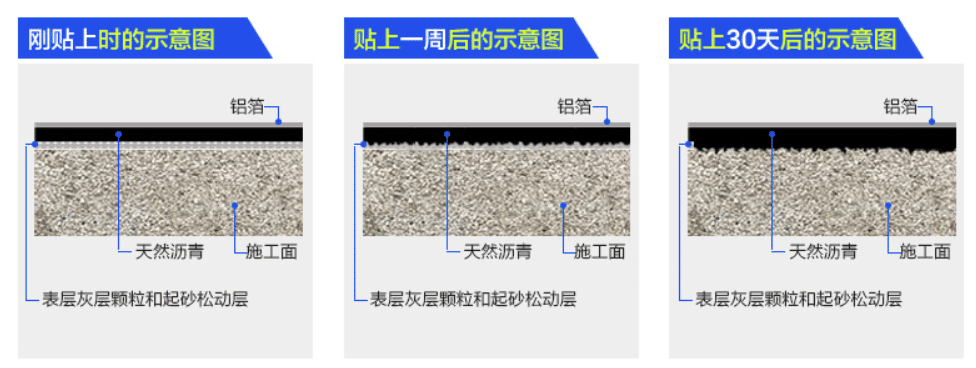
In theory, provided the surface is flat and dry, this heavy-duty adhesive provides immediate airtight and watertight sealing. (A close look at the manufacturer illustration reveals a slightly amusing logic flaw: as the bitumen creeps downward into the crack, the flat aluminum surface above shows zero indentation or deformation—a rather idealized artist rendering.)
3. Engineering Pitfalls: Hidden Risks of Patch-Style Repairs
While lowering the DIY barrier dramatically, several fatal physical and hydrological issues warrant serious attention:
1. Water Damming Caused by Seam Step Ledges
Waterproofing hates obstructions. The tape possesses physical thickness (typically 1.5mm to 3mm). When applying multiple strips across sloped roofs or flat decks, the edge of each tape layer forms a miniature retaining ledge.
- If taped against the direction of water drainage (counter-lap), rainwater flowing down the slope dams up against the seam edge.
- Puddled water combined with UV degradation and capillary suction will eventually force moisture underneath the edge. Trapping moisture
"**underneath the tape**"accelerates the internal corrosion of concrete reinforcement and steel panels!
2. Localized Patching Merely Displaces the Leak
Water is an opportunistic fluid. Many notice a ceiling drip and slap tape directly on the roof above it. However, water often enters through a hairline crack meters away, migrating along concrete grading or conduit paths before pooling and dripping at low spots.
- Sticking a
"**patch**"over the exit point simply blocks the surface outlet; the trapped water redirects to seep out in other corners of the room, failing to address the root source.
3. Thermal Cycling and Thermal Expansion Delamination
Rooftop temperatures in summer can exceed 60°C, while winter cold snaps plunge toward 10°C. Such severe temperature swings subject concrete and steel to significant thermal expansion and contraction.
- Despite aluminum UV shielding, sustained shear stress causes tape edges to curl, delaminate, or harden over years. Scraping away baked, petrified bitumen residue later is an engineering nightmare.
4. Proper Applications and DIY Installation Guide
Given these limitations, where does self-adhesive bitumen tape genuinely shine?
3 Keys to Successful DIY Installation:
- Thorough Surface Preparation: The surface must be cleared of dust, moss, and grease, and must be completely bone dry (application on damp surfaces fails within days).
- Firm Pressure Rolling: Once laid down, firmly roll or press outward from the center with a hard roller or cloth to expel all trapped air bubbles and bed the mastic into surface pores.
- Shingle-Style Overlap: When joining strips, always apply lower sections first and overlap upper layers downward by at least 5 cm, preventing counter-flow water dams.
Conclusion
Self-adhesive bitumen tape serves as a highly convenient "**architectural first-aid bandage**", working wonders on sudden small cracks or hardware joints. However, respecting the laws of fluid flow and material boundaries—avoiding indiscriminate large-scale tiling—ensures you protect your home’s structural integrity while saving money and effort!
Support Independent Perspectives & In-Depth Insights
Every thoughtful analysis and candid critique comes from our dedication to truth and quality. We choose not to follow sensational algorithms or clickbait headlines.
Sustaining independent research requires reader support. Make a one-time or monthly contribution, securely processed by Google.
Payments secured by Google · Manage or cancel anytime in your Google Account



Comments