
Anyone who uses GoDaddy’s domain registration services and frequently browses its administrative backend will have likely noticed the major incident that hit GoDaddy a few weeks ago: “Go Daddy-serviced Web sites go down; hacker takes credit”.
After an intense six-hour recovery effort stretching from 10:00 AM to 4:00 PM, CEO Scott Wagner issued the following statement:
Go Daddy Customers and Community, We owe you a big apology for the intermittent service outages we experienced on September 10th that may have impacted your website and your interaction with GoDaddy.com. The service outage was due to a series of internal network events that corrupted router data tables. Once the issues were identified, we took corrective actions to restore services for our customers and GoDaddy.com. We have implemented measures to prevent this from occurring again. At no time was any sensitive customer information, such as credit card data, passwords or names and addresses, compromised. Throughout our history, we have provided 99.999% uptime in our DNS infrastructure. This is the level of performance our customers have come to expect from us and that we expect from ourselves. We pride ourselves on providing world-class service — through our products, our site experience and customer care. We have let our customers down and we know it. I cannot express how sorry I am to those of you who were inconvenienced. We will learn from this. I’d like to express my profound gratitude to all our customers. We are thankful for your straightforward feedback and the confidence you have shown in us. In appreciation, we will reach out to affected customers in the coming days with a good faith gesture that acknowledges the disruption. We are grateful for your continued loyalty and support. If you have any questions or require further assistance, please call us at 1-480-505-8877. Sincerely, Scott Wagner Go Daddy CEO
Around the same time, I had been closely observing Google’s “Blogger | Blogspot” platform.
While rumors on the web circulated that GoDaddy suffered a massive DDoS attack launched by a hacker collective, GoDaddy’s official communication offered little further technical detail beyond mentioning corrupted router tables.
Google Blogger
Google Blogger is a widely popular blogging platform, and GoDaddy maintained a joint integration partnership with Google. Within Blogger’s settings backend, there is a configuration option for custom domains, allowing bloggers to choose between using a username.blogspot.com subdomain or binding their own custom domain (apex domain or subdomain).
Previously, Blogger offered a convenient shortcut under “Add a custom domain.” Users simply clicked the shortcut, authenticated with their GoDaddy account (beforehand or on the fly), and could input their subdomain in a dedicated field. GoDaddy would then automatically and swiftly inject the record into its DNS router tables, setting up seamless direct mapping. This frictionless user experience existed thanks to the partnership between Google and GoDaddy.
Reflecting on Wagner’s statement, he noted: “At no time was any sensitive customer information compromised… The service outage was due to a series of internal network events that corrupted router data tables. Once the issues were identified, we took corrective actions to restore services…”
The GoDaddy Attack Coincidence
Curiously, as soon as news broke that GoDaddy was compromised, Google immediately suspended the custom domain integration shortcut on Blogger, preventing users from relying on that automated flow. That timing, combined with the fact that GoDaddy’s outage was tied directly to routing tables, led me to suspect an underlying connection between the two events.
Checking Blogger again on September 30, I noticed that custom domain additions were re-enabled. However, just as I suspected, the automated shortcut had been discontinued. Instead, Google now guided users to a help document titled “How do I use a custom domain name for my blog?”, instructing users to manually configure CNAME records in their domain registrar’s DNS panel (such as GoDaddy).
In other words, the direct automated provisioning between Google Blogger and GoDaddy was shut down, requiring users to set up mappings manually.
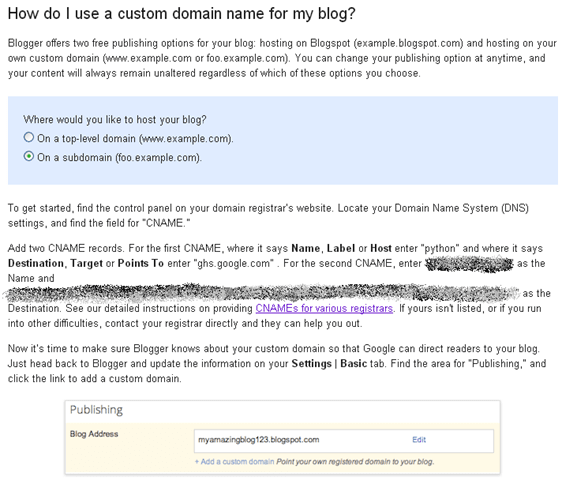 Google Blogger discontinued the automated shortcut and reverted to instructions on manually creating CNAME mappings.
Update on October 1: In the error dialog shown, one whole row of information had to be obscured. I initially assumed it was merely an alternative input option. But while configuring a custom domain just now, I discovered that Google not only requires users to manually input subdomain records, but they rushed out a security verification mechanism so urgently that the UI layout was unpolished, with the second target URL stretching well beyond the visual container.
In other words, anyone wanting to connect a custom domain must enter two separate verification records; otherwise, Google cannot resolve the domain name.
The image below shows the updated custom domain configuration fields. If CNAME mappings are not configured beforehand, an error message is triggered. Interestingly, prior to the service suspension, entering a domain without existing records did not produce this error.
Back then, entering either the custom domain or the original Blogspot URL would fail to connect because visiting the Blogspot URL instantly triggered an automatic redirect to the unresolved custom domain.
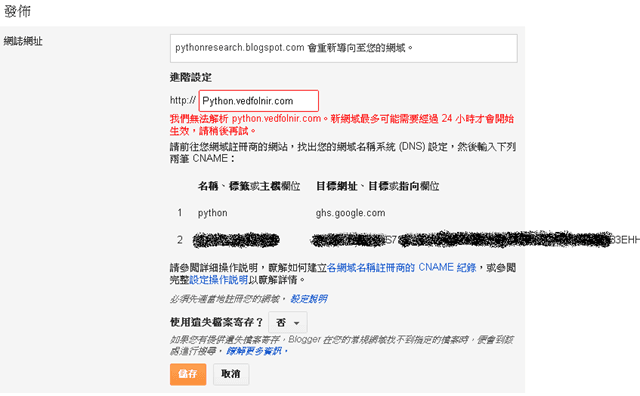 Error message shown when configuring custom domain settings in Blogger.
Findings and Discussion
Ultimately, I draw two possible conclusions:
- First, the GoDaddy disruption might have exploited the automated provisioning pipeline described above to corrupt routing tables;
- Second, this move represents a crisis of technical confidence from Google toward GoDaddy’s automated DNS hooks.
Whichever the case, GoDaddy has endured an unlucky streak ever since hemorrhaging customers during the SOPA (Stop Online Piracy Act) controversy.
Once again, please keep in mind that this article represents my speculative analysis based on observed phenomena, and does not claim to represent confirmed facts. It is best enjoyed as a piece of tech curiosity.
On a parting note: after Wagner issued his apology, GoDaddy offered customer compensation that turned out to be less appealing than standard promo codes (though after heavy criticism, they subsequently offered a deal for five domains at $5.98 each).
Update on October 5: A similar issue has affected Google Sites, which has also temporarily disabled custom URL mappings. Users intending to set up a new Google Site must manually configure domain forwarding in their registrar’s DNS panel for now.
Recommended Reading
- GoDaddy Official Website.
- GoDaddy Promo Codes and Coupons.
Support Independent Perspectives & In-Depth Insights
Every thoughtful analysis and candid critique comes from our dedication to truth and quality. We choose not to follow sensational algorithms or clickbait headlines.
Sustaining independent research requires reader support. Make a one-time or monthly contribution, securely processed by Google.
Payments secured by Google · Manage or cancel anytime in your Google Account



Comments