

I have always considered flashlights one of the crowning achievements of practical human technology. I am an avid fan of illumination gear—my fascination with flashlights easily rivals my passion for knives.
That said, I am not an unhinged collector; all the flashlights I have bought in my lifetime certainly number fewer than a hundred (maybe?). The era when my enthusiasm peaked was just prior to the widespread commercialization of high-output LED emitters.
Back then, everyone was obsessed with raw lumens; at one point, I nearly pulled the trigger on a hefty handheld searchlight (LOL).
That period could be classified as the second generation of modern flashlights, defined by rapid advances in surface coatings, xenon and halogen gas-filled bulbs, and ruggedized host architectures. It laid crucial groundwork for today’s third-generation LED torches.
In recent years, the rapid evolution of solid-state LED diodes paired with streamlined manufacturing across the strait has made high-quality flashlights accessible everywhere. Even a modest 100 NTD flashlight picked up at a roadside shop can perform remarkably well (barring extreme tactical or submersion conditions).
Take today’s perennial bestsellers built around Cree Q5 LED emitters: pumping out between 120 and 240 lumens, their performance leaves traditional incandescent flashlights in the dust.
Today, however, I am not here to sell you on flashlight tech, but rather to highlight a glaring structural flaw often found in flashlight design. Let this serve as our introduction.
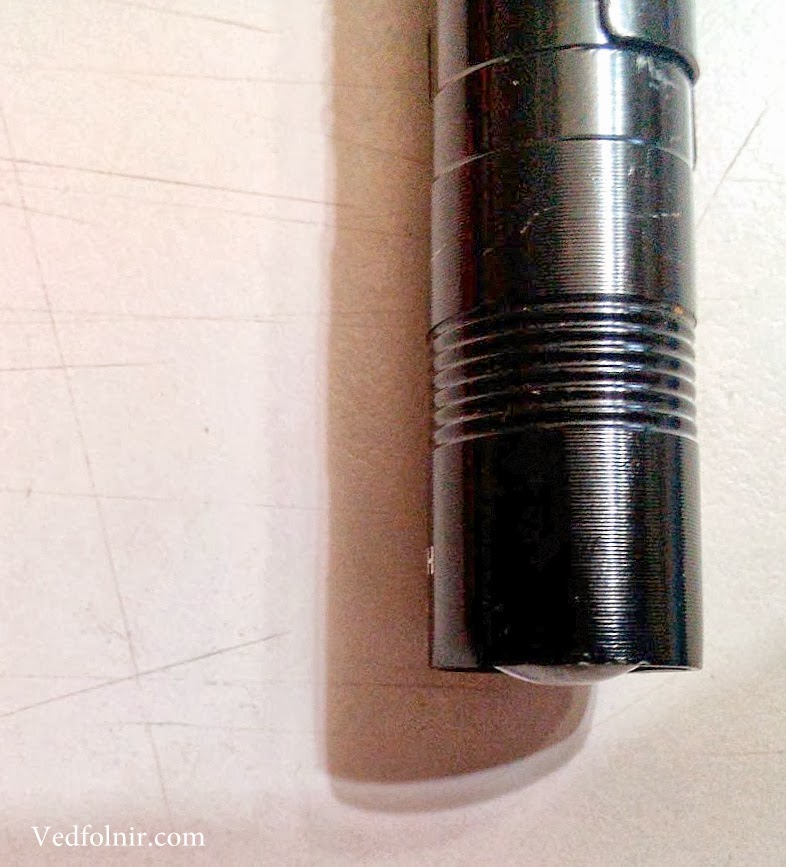 The protective lens of a typical budget flashlight.
The image above shows an inexpensive flashlight commonly found in discount stores. I spotted it at a friend’s house earlier this afternoon, and a fatal design flaw immediately jumped out at me.
My advice: avoid purchasing flashlights designed like this unless you are literally standing outside a pitch-black pedestrian tunnel without any light, where buying a cheap emergency torch from a grandma’s grocery store is your only alternative.
(And yes, I actually found myself in that exact predicament once—dragging my feet along an unlit tunnel wall, inching forward guided only by the faint glow of an ancient flip phone screen.)
So, have you spotted the flaw yet?
As you might have guessed, the front glass (or plastic) lens element protrudes past the protective metal bezel of the flashlight body.
Torches with this layout prioritize wide beam diffusion while completely ignoring the directional nature of LED emitters. Half-baked engineering inevitably yields a half-baked product.
I suspect the manufacturer simply recycled an outdated housing designed for dome-shaped incandescent or halogen bulbs and slapped a modern solid-state emitter inside without redesigning the bezel.
Furthermore, when the lens sits exposed past the protective rim of the head, it is subjected to direct abrasions, drops, and scratches. Unless the manufacturer uses ultra-hard sapphire crystal—which obviously never happens on budget lights—the front optic is doomed.
Over time, this exposed convex lens will become heavily scuffed and scratched. As passing light scatters across damaged optics, the flashlight’s usable lumen output and beam clarity will continuously degrade.
To wrap things up, flashlights saddled with this particular design flaw are thankfully a minority nowadays. But keeping this lesson in mind when browsing your next torch might save you from buying a frustrating piece of disposable gear.
Support Independent Perspectives & In-Depth Insights
Every thoughtful analysis and candid critique comes from our dedication to truth and quality. We choose not to follow sensational algorithms or clickbait headlines.
Sustaining independent research requires reader support. Make a one-time or monthly contribution, securely processed by Google.
Payments secured by Google · Manage or cancel anytime in your Google Account




Comments