
Before tablets dominated everyday mobility, and alongside bulky desktops and heavy laptops, one globally bestselling product virtually became synonymous with an entire computing era: the ASUS Eee PC. In 2008, this compact subnotebook won both the Gold Award and the Most Popular Product honor at the Taiwan Excellence Awards, celebrated worldwide as a pioneering father of the Netbook revolution!
Recently, however, an online rumor published under the pretense of “a dream” asserted that the genesis of the ASUS Eee PC was actually an accidental comedy of errors. Surprised by an article brimming with factual inaccuracies, senior ASUS veterans stepped forward to publicly demystify the true backstory.
(Original author: Yan Xiangyu) An article recently circulated online claiming insider knowledge of how ASUS’s legendary Eee PC came to life. After reading it, friends and colleagues reached out asking for the truth behind the gossip.
While the author disclaimed that “the following is purely fictional, any resemblance is coincidental,” it was clearly masking real corporate history.
To set the record straight, I consulted several key leaders still serving at ASUS who were instrumental in driving the Eee PC forward (including CEOs Jerry Shen and S.Y. Hsu). Here is the factual context to dispel misconceptions.
First, consider the landscape of 2005. Back then, notebook computers were remarkably heavy and expensive luxury items, with baseline models easily hovering around $1,000 USD. Modern ultralight laptops were still years away.
Broadband cellular networks were just beginning to touch public life. 3G was taking off, Taiwan Province was experimenting with WiMAX, and portable PCs were becoming an academic focus—yet nobody could predict how modern smartphones would later rewrite the world.
During that era, the “Wintel” alliance floated conceptual blueprints like MID (Mobile Internet Device) and UMPC (Ultra Mobile PC). However, Wintel’s early concepts were extraordinarily cost-prohibitive.
In 2005, Nicholas Negroponte of MIT launched the OLPC (One Laptop per Child) initiative. The goal was to engineer a $100 entry-level device offering fundamental computing, internet connectivity, and basic I/O to bridge the global digital divide.
(As an aside: in keeping with that spirit of bridging the digital divide, ASUS continues organizing international volunteer brigades to provide IT education in underserved overseas communities to this day.)
Even with AMD and Red Hat on board and Quanta Computer manufacturing the hardware, OLPC’s eventual bill of materials escalated past $188. Had OLPC adopted Intel CPUs and commercial Windows OS licenses, hitting a sub-$200 price point would have been unthinkable.
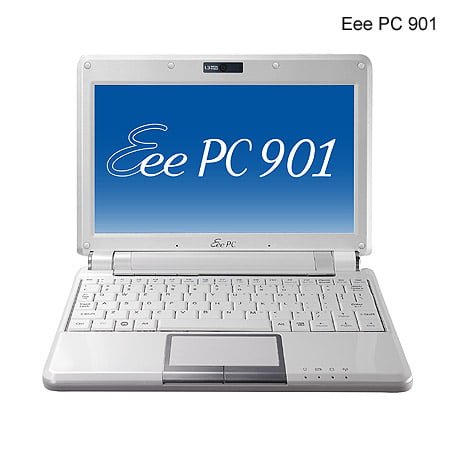
Fast-forward to June 2007 at Computex Taipei: the ASUS Eee PC made its international debut. ASUS’s motivation was never about launching a trivial skirmish against a single rival; it was inspired by the OLPC ethos—striving to build a consumer-friendly, accessible machine (Easy to play, Easy to learn, Easy to work) at an affordable price.
To bring the Eee PC to life, ASUS tackled two major hurdles:
- Reinventing the Business Model: When entry laptops averaged over $1,000 USD, deciding to release a $199 USD machine required tremendous internal courage—it meant disrupting ASUS’s own high-margin laptop lines.
- Re-architecting Hardware and OS: To hit aggressive price targets while guaranteeing responsive performance, ASUS boldly embraced flash storage (SSDs) years before the broader industry, paired with customized Linux operating systems.
The result was an unprecedented market sensation. Millions of Eee PCs shipped worldwide, demonstrating that lightweight, connected computing belonged in the hands of students, travelers, and everyday consumers. Far from an accidental blunder, the Eee PC was a deliberate, visionary leap that reshaped personal computing history.
Support Independent Perspectives & In-Depth Insights
Every thoughtful analysis and candid critique comes from our dedication to truth and quality. We choose not to follow sensational algorithms or clickbait headlines.
Sustaining independent research requires reader support. Make a one-time or monthly contribution, securely processed by Google.
Payments secured by Google · Manage or cancel anytime in your Google Account




Comments